Maidenhead Interview
The Interview — Maidenhead: On Old-School Thrash, Creative Evolution, and Maximum Clonage
Maidenhead has spent more than a decade forging an identity where old-school thrash precision collides with death metal aggression. With Maximum Clonage, the band expands that foundation through ambitious songwriting, diverse conceptual themes, and a creative vision that remains firmly rooted in underground metal.
This interview explores the creative force behind Maximum Clonage. Across thirteen questions, we discuss the band’s evolution, songwriting, conceptual storytelling, production, guest collaborations, and the old-school philosophy that continues to define Maidenhead.
Thirteen Questions constructed through old-school aggression, creative ambition, and uncompromising thrash conviction.
Q1: For readers discovering Maidenhead for the very first time, who are Maidenhead, and what vision have you pursued since forming in 2013?
Zack Roberts: Maidenhead is a metal band rooted primarily in thrash, but we also draw heavily from a lot of the extreme metal subgenres that started emerging in the 1980s and became more prominent through the 1990s. Since the band’s inception in 2013, the vision has been to help bring some of that old-school metal spirit back—especially thrash—while still pushing the songwriting forward.
We want to incorporate as many different influences and styles as possible without losing the core identity and aggression that comes from our thrash roots.
Q2: Maidenhead combines the speed and precision of classic thrash metal with the aggression and atmosphere of old-school death metal. How would you describe the band’s sound in your own words, and how has it evolved leading into Maximum Clonage?
Zack Roberts: I think our sound comes from taking the catchiness and strong songwriting instincts of bands like Megadeth and Metallica, then pushing that across the line into the aggression of death metal, along with more progressive song structures and some influence from more modern metal.
The biggest evolution from Decapitation of a Maiden to Maximum Clonage is really in the songwriting itself. A lot of the material on Decapitation of a Maiden was written when I was still in my teenage years and into the 2010s, when my playing and songwriting weren’t as developed or as structured as they are now. With Maximum Clonage, there was much more attention to detail in the arrangements, transitions, pacing, and overall construction of the songs. I think it shows a much greater sense of maturity.
The production is another major part of that evolution. In my opinion, the first record sounded a little too sterile and flat. On Maximum Clonage, working with Randy Burns—who has a long history with major extreme metal records from the 1980s and 1990s—helped give the material much more character and weight. That production style really complements the songwriting and makes the album feel much more complete.
Q3: Every band develops its own creative chemistry. How does the songwriting process work within Maidenhead, and how do individual ideas evolve into a finished Maidenhead composition?
Zack Roberts: We actually have a few different songwriting workflows depending on the song. On Decapitation of a Maiden, I wrote all of the guitar parts first, then Andre Forero and I worked through the arrangements together and he wrote his drum parts. I also wrote essentially all of the lyrics, aside from one song that had lyrics from a previous vocalist.
On Maximum Clonage, the process became much more varied. For some songs, I wrote the initial demo, Andre wrote his drums, and then we brought everything into the rehearsal room and refined the arrangement, added parts, and shaped the final instrumental version together. In other cases, I programmed drums first and wrote the guitar parts around them, then Andre learned and adapted those parts for the final recording. There were also songs where I gave Andre guitar-and-bass-only tracks and let him build his drum parts from scratch. So there were really three main instrumental workflows on this album.
Vocally and lyrically, the process was also more collaborative. Bella wanted to have a strong melodic footprint on the songs, but because English isn’t her first language, she didn’t want to be responsible for writing all of the lyrics. A lot of the time she would send me melodic ideas or scat vocals over the instrumentals, and I would write the words to fit those melodies. She also co-wrote parts of two songs. So for most of Maximum Clonage, the vocal melodies came from Bella and I developed the lyrics around them.
Q4: Although Maximum Clonage is not a continuous concept album, each hymn explores its own dark narrative. What inspired you to build the record around such varied themes rather than one overarching story?
Zack Roberts: Maximum Clonage isn’t a concept album, and lyrically I followed a similar format to what I did on Decapitation of a Maiden. I like having one central story piece tied to our mascot, Nada, while the rest of the album can explore completely different subjects.
On the first record, that central piece was “Decapitation of a Maiden.” On Maximum Clonage, it’s the title track, which also works as a kind of pseudo-sequel in Nada’s story. On the first album, he gets sent backward through time in a very Army of Darkness-type scenario. By the end of that story, the next step is that he gets thrown forward in time. The idea is that he has a broken time-travel device that can send him to random points in time and space, so it leaves the door open for him to show up anywhere on a future record. Outside of that, I really like having a wide range of lyrical themes. Some songs are more fictional or cinematic, while others come directly from things in my personal life. “False Masked Hero” is an example of that on this record, and songs like “To Estrange” and “Psychological Warfare” served a similar purpose on Decapitation of a Maiden.
I definitely wouldn’t rule out doing a full concept project at some point. If I did, though, I think I’d probably prefer a four- or five-song EP rather than a full album. That would let us really commit to one story or idea without stretching it too far or beating the subject matter into the ground.
Q5: The album moves between dystopian science fiction, body horror, war, survival horror, the occult, and dark fantasy. Which lyrical narrative proved the most rewarding—or challenging—to bring to life, and why?
Zack Roberts: I wouldn’t say any one song was especially difficult to bring to life from a lyrical standpoint. The real challenge across the album was having to fit my words to melodies that had already been established by someone else. That took a lot of refinement—rewriting lines, adjusting phrasing, and making sure the lyrics felt natural without sacrificing the meaning.
I’ve always felt pretty confident in my ability to write lyrics fairly quickly and still maintain a strong level of quality, so no single song stood out as dramatically harder than the others.
The most rewarding song for me lyrically was probably “False Masked Hero.” That song comes from some very real hardships and experiences in my life, and it gave me an outlet to express my frustration with people who will smile in your face, act supportive, and then turn around and speak badly about you behind your back.
I think that kind of behavior is something a lot of people can relate to. To me, those people are wearing a false mask—presenting one version of themselves directly to you while behaving completely differently when you’re not around, often while trying to claim some kind of moral superiority. Being able to channel that frustration into a song and confront that uglier side of human nature was extremely rewarding.
Q6: Instrumentally, how do you approach balancing razor-sharp thrash precision with the darker atmosphere and weight of old-school death metal?
Zack Roberts: I don’t think there’s a rigid formula for balancing thrash and death metal in our songs. A lot of it depends on what the song needs and what kind of atmosphere I’m trying to create.
If there’s a darker underlying theme, I’ll keep that in mind when I’m writing and lean into darker musical elements where they make sense. But overall, I think of songwriting almost like making a stew or a soup. You’ve got different ingredients and spices, and the goal is to use each one in the right amount rather than overloading the whole thing with one flavor.
Blast beats are a good example. They can immediately push a section further into death metal territory, but I don’t like to overuse them. I think they’re much more effective when they’re used in doses and placed where they actually add something.
As far as riffing goes, I usually don’t sit down and say, “Now I’m going to write a death metal riff” or “Now I’m going to write a thrash riff.” Sometimes that happens naturally, but most of the time I just write what fits the song. I’m actually more deliberate when I want to bring in something like black metal or grindcore, because those elements usually have a more specific character that I want to intentionally build into a section.
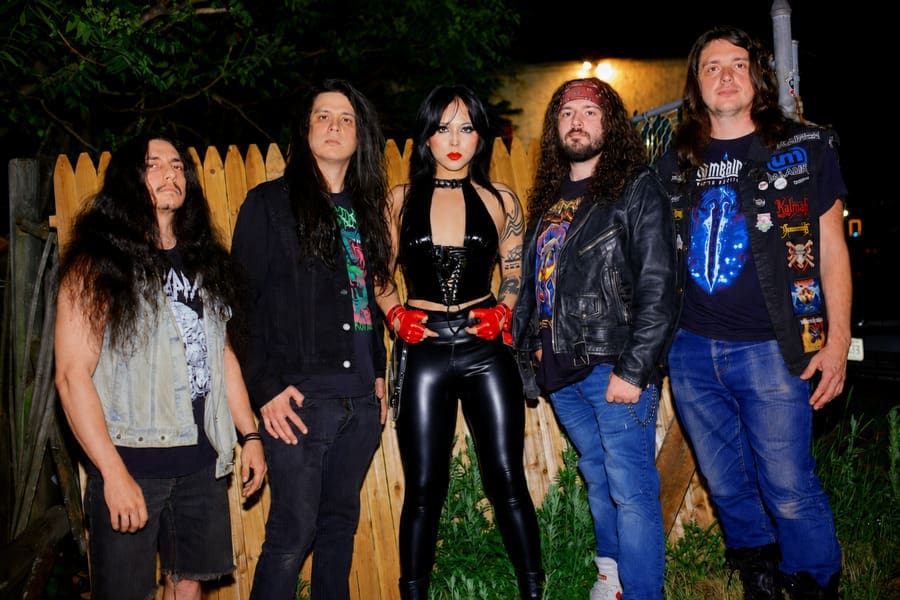
Q7: With the current five-piece line-up behind Maximum Clonage, how has the chemistry between the band members evolved, and how does that chemistry influence your songwriting today?
Zack Roberts: I wouldn’t say the chemistry has evolved dramatically in a songwriting sense, mainly because I’ve remained the primary songwriter. The biggest change there has been adapting my lyrics to melodies that someone else has written, which added a different collaborative dynamic than we had before. Where the chemistry has really evolved is in the band itself, especially live. I think it’s the best it has ever been. The original lineup ultimately wasn’t the right fit and didn’t last very long because the overall dynamic just wasn’t working for us.
When Bella and Vance joined in 2024, and then Lawrence joined in 2026, I felt like there was a massive step up in both professionalism and technical ability. I think that translates very clearly onstage, and I think audiences can see it too.
Just as importantly, the personal dynamic is much healthier. Everybody is friendly, easy to be around, and for the most part we all get along really well. That makes rehearsals, shows, traveling, and everything around the band a much better experience. So even if the songwriting process is still largely driven by me, the chemistry of the actual group has improved tremendously.
Q8: Maximum Clonage features guest musicians including Chris Poland, Glen Drover, Chen Wang, Daniel Herrera, Mykhailo Kobets, and Rich Gray. How did these collaborations come about, and what did each guest contribute to the finished album?
Zack Roberts: Chris Poland came about through a relationship that had already existed for a few years. I met Chris at a convention, and for a period of time we stayed in touch, talked about music, and he mentioned that he’d be interested in contributing to the album. We lost contact for a while, but later Randy Burns came into the picture. Randy and I had already been friends online, and he was mixing the record while also working on Chris Poland’s Return to Metalopolis remix/remaster. Randy offered to reconnect us about the guest solo, Chris graciously agreed, and that’s how he ended up playing on “Kill Or Be Killed.” Glen Drover came together in a similar way. We had been friends online and had discussed the possibility of him doing a guest solo. He agreed to contribute, and he ended up playing on “False Masked Hero.”
Chen Wang is an absolutely monstrous guitarist and a Berklee graduate who has also filled in for Maidenhead whenever Vance is unavailable because of commitments with his other bands. Chen is the first person we call because his technical ability is incredible and he can learn almost anything we throw at him very quickly. He also became a close friend of mine. For “Hasta La Proxima,” I came up with the two main melodies and then had Chen build layer after layer around them. He added a huge amount of depth to the song, bounced ideas back and forth with me, and made suggestions that expanded on the melodies I already had.
Rich Gray originally came in because I hired him to play bass on the title track, “Maximum Clonage.” During that process, we ended up parting ways with our previous bassist and didn’t yet have someone permanent in the role, so I asked Rich to play on the rest of the record as well. He learned everything completely by ear and finished the material in about two days. It was honestly a masterclass in bass playing.
Daniel Herrera was brought in because I wanted a really strong synth player to help create an atmospheric intro inspired by the soundtrack to the game Killing Floor. A lot of the lyrical imagery in “Maximum Clonage” is influenced by that game, so it made sense for the intro to connect directly to it. The result became “Enter The Killing Floor,” which leads straight into the title track.
Finally, I brought in Mykhailo Kobets to play trumpet on “Hasta La Proxima.” I wanted the song to have more of a Spanish flavor and a greater sense of theatricality and finality as the closing piece on the record. The trumpet helped give it that extra character and made the ending feel much more distinctive.
Q9: Production duties on Maximum Clonage were shared between multiple engineers and mixers. How did you ensure the album retained a cohesive sonic identity despite those different production approaches?
Zack Roberts: A lot of the recording and production schedule for Maximum Clonage was driven by tight deadlines, so we had to make practical decisions as we went. Randy Burns handled the core of the record—tracks two through seven—which are really the main body of the album. He mixed all of those songs, so that gave the record a strong central sonic identity.
For “Enter The Killing Floor,” Bella mixed Daniel Herrera’s synth stems. That was a much shorter piece and relatively straightforward compared to the full songs, so it didn’t make sense to spend a large amount on mixing a one-minute intro. Bella also studied engineering at Berklee, so she was more than capable of handling it.
“Hasta La Proxima” came together after Randy had already finished his work on tracks two through seven, so we were no longer contracting him at that point. We still wanted the outro to sit naturally beside the rest of the album, so we brought in Dan Saillant. Dan had also filled in on bass for us live for a period of time after we parted ways with our previous bassist, and he’s a very capable mix engineer, so it was a natural fit. He ended up mixing the outro and then mastering the entire record.
I wouldn’t say there was some elaborate master plan on our end to force all three mixes into one exact sonic mold. A lot of that cohesion really came down to the engineers listening to what had already been done and working in a way that complemented it. I think they did a fantastic job, because when you listen to the album from beginning to end, I don’t think the transitions between the different mixers are obvious at all.
Q10: Randy Burns has worked on numerous landmark metal releases throughout his career. What was it like collaborating with him on Maximum Clonage, and was there anything about his approach that particularly influenced the finished album?
Zack Roberts: Working with Randy was absolutely a bucket-list experience for me. He worked on records like Death’s Scream Bloody Gore and Megadeth’s Peace Sells… But Who’s Buying?, and Megadeth is probably my single biggest musical influence, so getting the chance to work with someone who was involved in that history was incredible.
I think one of Randy’s biggest influences on the record came from his experience and the way he kept things moving. He was very firm about deadlines, which forced us to make decisions, stay focused, and get everything to the highest quality we could within a real time frame.
Sonically, his decades of experience were a huge part of shaping the album. Some of the effects and production choices he used had a very old-school character, and he also ran material through analog gear, which helped give the record that balance between a classic metal sound and a more modern production approach.
He had a major impact on the overall sound of Maximum Clonage, and I think the record benefited enormously from having his experience behind it.
Q11: The album closes with the instrumental Hasta La Proxima. What made an instrumental the right way to conclude the journey, and what role does that composition play within the album as a whole?
Zack Roberts: I think closing the record with “Hasta La Proxima” was the right decision because “Burst Stream Of Destruction” ends on such a high climax and then fades out. Having the instrumental fade in afterward gives the album a more somber, reflective ending—almost like a musical way of saying, “until next time.”
That idea is also built into the artwork for “Hasta La Proxima.” There’s a computer screen displaying a number code, and using a coding language I found, that message also translates to “until next time.” It’s a small Easter egg, but it reinforces the entire purpose of the track.
So the song works as both a conclusion and a promise. It closes Maximum Clonage on a more cinematic note while also telling people that Maidenhead isn’t finished. We’ll absolutely be back with another record.
Q12: With Maximum Clonage arriving on 14 August 2026, what are your ambitions for the album, and what lies ahead for Maidenhead beyond its release?
Zack Roberts: Our first ambition is obviously to get the record out there and have it connect with people. We hope it performs well, gets strong reviews, and helps establish Maidenhead on a more professional level.
Before release, we sent the album to a number of labels, but we didn’t receive an offer that made enough sense for us to move forward with. At that point, it felt more practical to finance the promotion and distribution ourselves through my company, ZR Media.
What I’d really like Maximum Clonage to do is raise the band’s profile enough that the next release attracts more serious label interest, helps us secure stronger touring opportunities with larger acts, and gives us more room to expand Maidenhead beyond just the music.
A big part of that is continuing to develop Nada, our mascot, as a character and building more lore around him with each release. We’re even developing a Sega Genesis-style platform shooter based around the story and visual world of the title track, so there’s a lot of effort going into making Maidenhead feel like a larger creative universe rather than just a band.
We’d also love to find the right opportunity for a vinyl release. Overall, the goal is to keep growing Maidenhead as both a musical name and a recognizable brand, while continuing Nada’s story through future records and other creative projects.
Q13: Finally, if someone were to experience just one Maidenhead release before hearing Maximum Clonage, which release would you recommend, and why does it best represent the band today?
Zack Roberts: The only other full-length release we have is Decapitation of a Maiden, so by default that would be the one I’d recommend. It does feature a different vocalist, so there are some obvious sonic differences compared with what people would hear from us live now or on Maximum Clonage.
If I had to point someone toward one song from that record, though, I’d probably choose “To Estrange.” That song is especially personal to me because it was written about my best friend of many years who passed away a few years ago. She also created the artwork for the single, so that song carries a lot of emotional weight for me beyond just the music itself.
If someone wanted something that represents the current version of Maidenhead more closely, I’d probably point them toward one of the singles from Maximum Clonage, like “Death March” or “Magia Obscura.”
But as far as a previous full release goes, Decapitation of a Maiden is really the only answer.
If there’s anything you’d like to add — your creative process, or something we haven’t touched on — please feel free to do so here.
Zack Roberts: Closing Prompt:
The main thing I’d like to say is thank you to everybody who took the time to read this. I really hope people pick up a physical copy of Maximum Clonage on or after August 14. For a smaller independent band like us, that kind of support genuinely makes a difference and helps push the record toward being successful.
I also want to thank you, Kris, for taking the time to put these questions together. These are honestly some of the best questions I’ve been asked in an interview for this band, and I really appreciate the thought that went into them.
And if you get the chance, come check us out live. If you’re a promoter, or you’re in a band yourself somewhere else in the United States or internationally, absolutely reach out to us about putting together shows, tour dates, or future opportunities. We want to take Maidenhead as far around the world as we possibly can, and that kind of growth depends on the people supporting us just as much as it depends on us.
Thank you again for your time, your questions, and for giving us the opportunity to talk about the record.
This closes the interview. The rite is complete — the voice of Zack Roberts now etched into the archive of sin.
I extend my deepest thanks to Zack Roberts/Maidenhead for sharing their voice — and to the reader, for bearing witness to this craft-rite.