Anasarca Interview
The Interview — Anasarca: Death Metal Heritage, Grief, Mortality, Artistic Integrity & Underground Independence
Anasarca stands as an uncompromising force within Germany’s death metal underground, with a legacy stretching back to 1995. Forged through decades of musical evolution, personal challenges and an unwavering dedication to old-school brutality, the entity continues to channel raw aggression and deeply human experiences into its music. Their fifth full-length album, Achlys, confronts grief, mortality and the devastating emotional weight of losing loved ones.
This interview explores the history and creative world behind Anasarca. Across thirteen questions, we journey through the entity’s origins, musical philosophy, the deeply personal experiences shaping Achlys, its uncompromising approach to recording, and Mike’s outspoken perspectives on social media, MetalUnites and METALLIVERSE.
Thirteen Questions constructed through death metal heritage, grief, mortality, artistic integrity & underground independence.
Q1: Hailing from Germany, Anasarca is an established death metal entity with a history spanning several decades. Could you introduce yourselves to the readers of Athenaeum of Sin, including the current members and their respective roles, and explain how Anasarca originally came together?
Mike: In 1995, Heiner (drums) and I left our band at the time, Vomiting Corpses, due to personal differences and formed Anasarca.
Just seven days later, we headed into the studio to record our first demo, “Condemned Truth.” For those interested: the French label Metal Exhumator has released a limited edition CD compilation featuring all of our demos—including, of course, the five tracks from that first demo—alongside our first limited-edition live album.
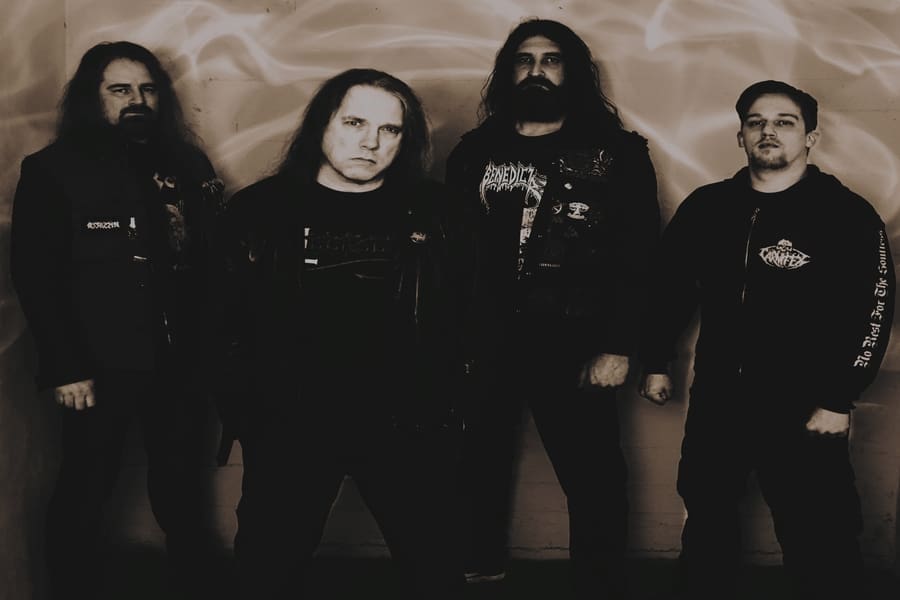
The current lineup consists of Alf (drums), Carsten (guitar), Björn (bass), and myself, Mike (vocals/guitar).
Björn is currently on paternity leave, however, so we are in the process of bringing in a new bassist named Nick, who hails from the Netherlands.
Q2: Throughout its history, Anasarca has remained rooted in the uncompromising traditions of death metal. What originally attracted you to this particular musical style, which entities influenced your early development, and how has your understanding of death metal evolved over the years?
Mike: Phew, that’s a tough one to answer.
For starters, back in the day, Vomiting Corpses was a band that developed a different style compared to other German bands of that era.
Frank Spinka and I were the primary songwriters, and we complemented each other very well when it came to the riffing. I wrote the kind of riffs that define Anasarca today, while Spinka brought in influences from bands like Voivod.
When we later formed Anasarca, the style was naturally shaped by my riffing, since I was writing all the songs.
Old-school death metal has always been what I wanted to play—and what I still want to play today. The only real change over time is that the drumming has become increasingly fast, which also had to do with the specific skills of each drummer we’ve had.
In the beginning, Heiner wasn’t much of a fan of blast beats—and besides, blast beats back then weren’t as fast as they are today.
Herb then took things to an entirely new level; he came from the grindcore and brutal death metal scene of that time and was a fan of bands like Cryptopsy and Suffocation.
Dirk then raised the bar even further on the Survival Mode album, and well, with Alf, it’s finally exactly what I’ve always envisioned.
My approach to the death metal we create hasn’t changed. It’s not something that should be confined to rigid structures or follow strict rules. Anasarca songs have always been written purely from the gut. At first, Alf struggled a bit with this because we didn’t use clear, predictable structures—for instance, a riff might be played for one-third of a section, then for two-thirds when it repeats, and so on.
But I think that’s precisely what makes it what it is.
Generally speaking, though, I’m not really into modern death metal anymore. To me, it feels too technical, too forced in its complexity—too many riffs packed into a single song, with no clear, cohesive thread running through it. Often, I find the songwriting too chaotic. But then again, that’s just a matter of taste. I still prefer listening to albums by bands from the 90s and 2000s.
Q3: Maintaining a musical entity across several decades inevitably brings periods of change, challenges and personal development. Looking back upon Anasarca‘s history, which experiences or turning points have had the greatest influence on the entity’s identity and continued existence?
Mike: We frequently dealt with lineup changes—which is common when you’re young, as people’s perspectives shift, band members clash, or musical tastes simply evolve.
By 2004, I decided to pull the plug, as too many negative elements had crept in. On top of that, my now-wife had two children, and I was pursuing my studies; everything just didn’t feel right anymore. In 2007, I cut my hair, thinking I needed to become “serious”— believing a “proper” job required it so I could provide for my family.
I stepped away from the scene entirely until 2012.
Once the kids were a bit older, I realized I couldn’t live without music, so I found some people to play our old songs with—just getting together, rehearsing, having a few beers, and enjoying ourselves. But then word got out that Anasarca was back, and things took off again. It had to start up again; otherwise, SURVIVAL MODE and ACHLYS would never have come into existence.
Q4: On 3rd April 2026, Anasarca released its fifth full-length album,Achlys, through Selfmadegod Records. Could you discuss the creative journey behind the album, what inspired its title, and how its underlying concept began to take shape?
Mike: There wasn’t a specific creative process for this individual album.
Rather, there is an ongoing creative process, because songwriting happens constantly.
I keep a guitar at my desk, and whenever an idea strikes, I record it. When I have some spare time, I pick up the guitar and jam a bit; every now and then, an idea emerges that I then record.
I still have a multitude of unused riffs and ideas that I experiment with for new songs.
But there are also moments when an idea comes up in the rehearsal room, and we flesh it out right then and there.
„ACHLYS“ is a blend of all these approaches:
Songs that already existed and were further developed, individual riffs that we pieced together into a song, and tracks that came into being within just two or three sessions in the rehearsal room.
This time, the concept was born out of personal experience. Between 2017 and 2019, I lost five family members, followed by a beloved dog in 2022 and several friends thereafter. The grief was so overwhelming that I felt I had to process this horror—a horror that every single person on this planet eventually faces. Many of the songs were already nearly complete, so the concept didn’t influence the songwriting, nor did the songwriting shape the concept. In the end, they simply fit together perfectly.
Q5: Achlys explores deeply personal subjects surrounding grief, loss and bereavement. What motivated Anasarca to confront these experiences through death metal, and what do you hope listeners will take away from the album’s lyrical and emotional content?
Mike: As I’ve said, grief is an experience that EVERYONE goes through at some point—and it’s then, if not before, that you truly realize what it means to lose a loved one.
We can try to act tough, projecting an image of being untouchable, strong, and above it all.
But in that moment, everyone becomes an emotional wreck—whether they realize it or not.
And it takes time to pull oneself back out of that state.
I want to help listeners understand that having your loved ones by your side is neither “normal” nor something to be taken for granted.
A single, fleeting moment—like an accident—can change a life forever.
Or you might watch a loved one fall ill, fading away over days, weeks, months, or even years—and you inevitably suffer right along with them.
I believe the message of this album is: take care of your loved ones, and create memories.
Q6: One particularly interesting aspect of Achlys is the involvement of individuals who have experienced the loss of loved ones in contributing to its lyrical material. How did these contributions come about, and how did you approach transforming such deeply personal experiences into musical compositions while preserving their original meaning?
Mike: I approached it exactly the same way I did for Moribund and Dying: I went searching—in the case of ACHLYS, looking for poems and other writings composed by people experiencing grief.
I then took that selection and examined which text might fit which song, aiming to make as few changes as possible so as not to dilute the original content.
There were many highly emotional texts that, in terms of theme, would have been an even better or more intense fit—but not all of them were suitable for being adapted to the songs.
Q7: Turning towards the instrumentation, Anasarca‘s musical identity is built upon aggressive guitar work, a powerful rhythm section and uncompromising death metal vocals. How did you approach the songwriting and instrumental arrangements for Achlys, and were there any particular techniques or musical ideas you wanted to develop further?
Mike: No, everything that emerges musically in Anasarca comes straight from the gut. Nothing is structured or planned. How often a particular part recurs, when a transition happens, and how it unfolds—it’s all intuitive. That has always been the challenge.
Some bands build their songs around lyrics. We have complete freedom until the song itself is finished and works well as an instrumental piece.
The vocals usually just make it even better—different, for sure, but almost always definitively better. That’s when the songs truly begin to come alive.
Q8: Throughout Achlys, Anasarca explores death through the deeply human experience of grief and bereavement. How did the album’s subject matter influence your decisions concerning vocal expression, musical atmosphere and the balance between aggression and emotional depth?
Mike: As previously mentioned, the concept had no direct influence on the songwriting process.
It did, however, have an enormous impact on the vocals; reading lyrics is one thing, but bringing them to life within a song during the album recording sessions is something else entirely.
I had adapted the lyrics and read them many times—but during the actual recording, fueled by the adrenaline of the moment, the words triggered emotions that can now be heard in my voice.
I am a father myself, and while recording “How Can They,” for instance, I broke down in tears—they streamed down my cheeks—because I was able to empathize so deeply with the situation of losing a child, imagining it as if one of my own children had died young.
Q9: The recording and production process can have a considerable influence on how death metal communicates its intensity. How was Achlys recorded and produced, and what were your priorities when establishing the album’s overall sound?
Mike: We’re old geezers.
We’re analog.
We don’t use Kemper amps, and we don’t use in-ear monitoring systems.
As with all our previous albums, our goal was to keep the analog sound front and center. We only used a digital device for a single guitar track; everything else was recorded using four different amplifiers—captured the traditional way, with microphones placed in front of the speaker cabinets.
The drums are analog, too—the only exception being a small trigger on the bass drums.
And honestly? That’s exactly what we achieved. That’s what we set out to do, and you can really hear the difference when you compare it to other records today, which often sound too polished—too much like they were put together entirely on a computer.
It’s always been important to us to record in a “proper” studio, rather than just half heartedly messing around with software on a PC at home. Death Metal is, after all, a craft—it’s manual work.
Daniel did an incredible job as producer; he put a massive amount of work and heart and soul into the whole thing.
I’m really looking forward to the upcoming album from his own band, BOKOR, who recently recorded with him.
Q10: The visual presentation of an album can provide an important connection to its underlying themes. What inspired the artwork and visual identity of Achlys, and how do these elements reflect the concepts explored throughout the recording?
Mike: Once again, we are absolutely thrilled with what Robert Sindermann has created for us here.
He had already designed the covers for GODMACHINE, MORIBUND, and SURVIVAL MODE…
When we recorded our 2024 promo, Goddess of the Somber Shade, the lyrical concept was already in place. For this demo, Rob created the figure of ACHLYS—the “goddess,” so to speak.
Once the concept was solidified, we discussed various ideas, potential color schemes, and so on.
We were immediately impressed by what he produced for the demo and knew we were heading in the right direction.
Eventually, we received an initial draft that we already really liked. My bandmates had just one requested change regarding the figure of Achlys; Rob revisited the character from the demo, and then everything fell perfectly into place.
He consistently manages to provide a visual complement to the music we present on our albums.
The darkness of the ACHLYS cover, its morbidity, and that bleak atmosphere—in our eyes, it’s perfect.
Once again, we are incredibly grateful to him!
Q11: With Achlys representing Anasarca‘s fifth full-length release, how do you feel it compares with your earlier recordings? Are there particular developments in songwriting, musicianship or artistic perspective that distinguish this album from its predecessors?
Mike: Back then, everything sounded very raw due to the recording techniques and the studio environment. Musically, Godmachine stood apart from other bands of that era—at least within the German scene.
Today, I would say that Anasarca is fundamentally different from other bands; you will always be able to recognize our sound.
Naturally, we’ve matured and our technical skills have improved—but our standards for the music, lyrics, and concepts have remained just as high.
There wasn’t a specific concept behind Godmachine, but everything that followed has been meaningful to me.
I don’t want to create dull, run-of-the-mill material; I want to craft something sophisticated—something I can still be proud of down the line. I want listeners to engage not just with the music, but also with the themes behind it.
That’s arguably even more important today than it was back then.
As for the production, I’d say we are most satisfied with Achlys when compared to our older albums—even though I still absolutely adore those early records.
Q12: Beyond Anasarca, you have also mentioned your involvement with MetalUnites and METALLIVERSE. Could you introduce these ventures to our readers, explain the ideas behind their creation, and discuss what you hope to achieve through them?
Mike: Look, I have been part of the metal scene for over 40 years and have witnessed many changes during that time—from fanzines and classic scene magazines to internet forums, and now, today’s social networks. It all began in 2016 with the idea of creating my platform, MetalUnites. The concept was to curate videos from sources like YouTube and organize them by genre, much like Netflix.
It has always annoyed me that when you search for a band name—like our colleagues in the band MONSTER—on YouTube, the first 12 pages of results are filled with energy drinks, scantily clad women, big fish, horror movies, and so on. You might not find an actual video of MONSTER until page 13 or later—by which point I’ve usually given up the search.
For years, I’ve been hunting for videos from lesser-known bands, and I still frequently come across clips that have been online for a decade or more, yet I’d never seen them before. My own band, Anasarca, faces the same issue; we’re nearly impossible to find, even though videos of us from nine years ago exist. That was the initial spark for MetalUnites. Furthermore, we produce our own professional videos with bands, which are available exclusively to our MetalUnites members.
We also have a partner program: members at the “METALHEAD” and “WARRIOR” tiers gain access to special offers from our partners. They receive a membership card that can be used to claim discounts or gifts—such as reduced ticket prices, merchandise deals, free drinks, or discounts on tattoos—at locations all around the world. It’s all still a work in progress. The “METALLIVERSE” was a logical next step.
While Facebook and Instagram have become essential communication tools for bands, promoters, magazines, and fans, you are always just a small part of a massive platform where metal exists alongside countless other, unrelated topics. Then there are the algorithms, the advertisements, and ever-growing commercial interests. For years, it has really pissed me off that a small band on Facebook only gets a reach of 2–5%— unless you pay for that reach. So, when we post news, only about 40 to 100 of our 2,000 followers actually see it. I have good friends who almost NEVER see anything from us, and they end up annoyed that they missed out on things like exclusive t-shirts.
It’s not just me, either; it’s the same for event organizers, shop owners, and pub operators—and, ultimately, the average user gets screwed over, too. On top of that, there are two other things that really grind my gears. It’s one thing for Meta to decide what people get to see, but the fact that bots and trolls—spreading hate and vitriol—are given free rein without any consequences is simply intolerable.
Furthermore, you’re bombarded with ads that you have absolutely no interest in. And soon, users might even have to pay a monthly fee—for instance, if they want to include more than two links to their own website. Meta makes money by selling our data to advertisers, who then flood us with their content. On top of that, reaching people will soon become impossible without paying. “Meta One” is on the way, with monthly costs ranging from 5 to 500 euros (!) — starting with companies and bands that need reach, but the average user will follow.
I’d bet on it. So, at some point, I asked myself: Why isn’t there a dedicated digital space where the metal scene can truly connect? A place where fans, bands, labels, promoters, festivals, magazines, and fan clubs can all come together—without metal just being one category among many others. This line of thought led to the creation of METALLIVERSE. The goal was not to simply produce a copy of Facebook, but rather to build a platform consistently tailored to the needs of the metal scene.
Consequently, I built METALLIVERSE on the Friendica framework (part of the Fediverse)—a social network designed for metal fans. There are no algorithms here; bands can control who sees their content and how much of it is visible, while users can decide what they want to see from bands (or other profiles) and whether or not they wish to be discoverable themselves. Advertising is restricted to designated groups and is always relevant to the metal genre. Everything is displayed chronologically; it is the users—not us, as the platform—who determine what is seen.
Furthermore, all data remains with the user; nothing is shared with third parties. We have now launched the first instance, “Metal.METALLIVERSE.” Each instance will be capped at 3,000 users, and we hope to eventually reach 25 such instances, setting a total capacity of 75,000 users.
The reason for this is simple: we want an active community, not a collection of dormant, abandoned accounts.
All instances will be interconnected to function as one large network, with specific instances such as
“Deathmetal.METALLIVERSE,”
“Blackmetal.METALLIVERSE,”
“Heavymetal.METALLIVERSE,”
“Powermetal.METALLIVERSE,” and so on.
you can gather information at www.metalunites.com (for MetalUnites in general) or www.metalliverse.de/en for information about the Metal social Network METALLIVERSE.
Q13: Looking towards the future, what ambitions remain for Anasarca following the release of Achlys? Are there plans for further recordings, live performances or other developments that you would like to share with the readers of Athenaeum of Sin?
Mike: We definitely want to record at least one more album—and play live as often as we possibly can. Unfortunately, we don’t get many opportunities, since we work without a booking agency.
Anyone who has seen us live is blown away by the brutality we unleash… but there aren’t many people willing to book us. Sadly.
The Open Invitation: Finally, is there anything you would like to share with the readers of Athenaeum of Sin that we have not explored throughout this interview?
The floor is entirely yours.
Mike: I think we’ve covered everything. I’d be thrilled if lots of people signed up to become members of MetalUnites or the METALLIVERSE.
Also, we’d love to hear from anyone interested in booking us for live shows.
We old guys want to show you youngsters how it’s really done! 🙂
A huge thanks for your support with this interview—best regards to all the Death Metal maniacs out there.
Check out our new album ACHLYS (Selfmadegod Records), our live album Three Decades of Pure Death Metal, and the demo compilation The Demo(n)s (both via Metal Exhumator).
This closes the interview. The rite is complete — the voice of Mike now etched into the archive of sin.
I extend my deepest thanks to Mike for sharing their voice — and to the reader, for bearing witness to this craft-rite.