Azraël Interview
The Interview — Azraël: On Time, Memory, and Unfinished Legacies
Formed upon the Ligurian coast in 1988, Azraël emerged during the final years of the classic heavy metal underground before vanishing into silence. More than three decades later, the entity has returned with its debut EP, Clockwork Abyss—a record carrying the spirit of the late 1980s into the present day without compromise or modern reinvention.
This interview descends into the conceptual world behind Clockwork Abyss. Across thirteen questions, we explore the archaeology of memory, the preservation of artistic identity, the Ligurian metal underground, and the remarkable journey behind a debut release thirty-eight years in the making.
Thirteen Questions constructed through time, memory & unfinished legacies.
Q1: Azraël was originally formed in 1988 and then fell silent for more than three decades. When you first decided to reactivate the band, what emotions surfaced most strongly—excitement, uncertainty, nostalgia, or something else entirely?
Azraël: The honest answer is that it never really felt like a decision. It felt like a debt being called in. Andy carried this band’s name around for thirty years, through everything life threw at him, and the door was never properly closed, just left ajar since 1994. So when we finally pushed it open, the strongest feeling was not nostalgia, it was urgency. A sense of “right, we owe these songs an existence, let’s get to work”.
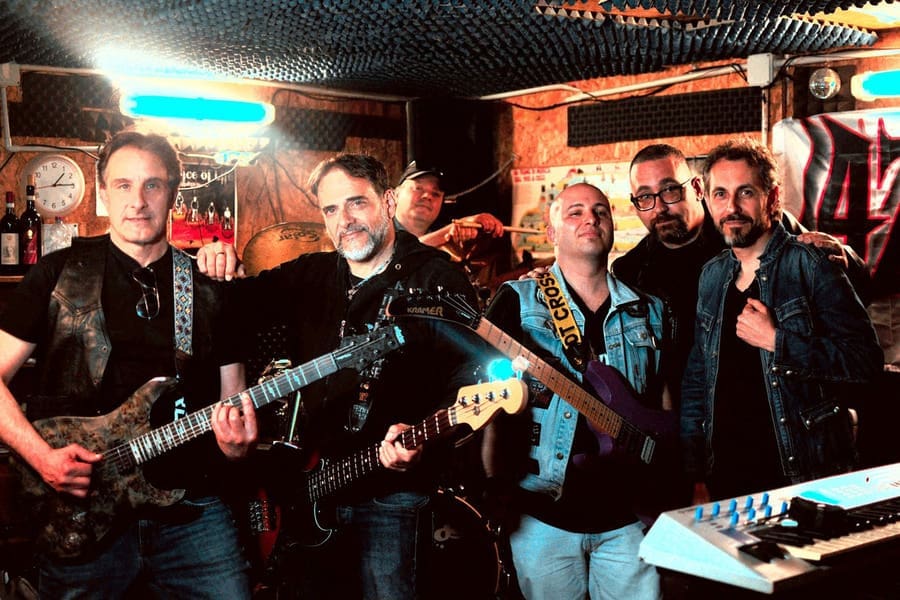
Of course there was uncertainty too. Coming back after that long, you ask yourself whether you can still do justice to the thing you loved. But the first time the six of us hit a chorus together in the rehearsal room, that question answered itself. Nostalgia is a lovely passenger and a terrible driver. We keep it in the back seat.
Q2: Many bands return by reinterpreting their past through a modern lens. Azraël instead chose to preserve the spirit of the late 1980s. Why was maintaining that original identity so important?
Azraël: Because it would have been a lie otherwise. This is not an aesthetic we picked off a shelf, it is simply the musical language we actually speak. We grew up inside those records, we learnt to play by wearing them out, and when we write, that is what comes out naturally.
Coming back dressed in modern production tricks and downtuned guitars would have been a costume, and people can smell a costume from the back of the venue. We would rather be genuinely ourselves in 2026 than a convincing imitation of someone else. The spirit of the late ’80s is not a marketing angle for us. It is home.
Q3: The Ligurian metal scene is rarely discussed compared with larger European scenes. What was the atmosphere like for a young heavy metal band growing up between Genoa, Rapallo, and Recco during that era?
Azraël: Small, stubborn and completely hand-made. There was no internet, no scene report, no playlist. There was a note that Ale Arbocò pinned up in the record shops between Genova and Recco, looking for musicians on his wavelength, and that piece of paper is the reason this band exists. Everything ran on flyers, borrowed gear, tapes passed from hand to hand and friends who would do anything for you.
People like Manuela Nattino shared stages with us, and almost everyone in our circle ended up involved sooner or later, behind the desk, hauling cabs, or down the front singing themselves hoarse. It was a scene where nobody was watching from the outside, so the only reason to do it was love. That stayed with us. It still shapes how we treat people today.
Q4: If you could place the 1988 version of Azraël in the same room as the 2026 version, what do you think each incarnation would say to the other?
Azraël: The 1988 lads would probably ask what on earth took us so long, and then ask why some of us have less hair. The 2026 version would tell them two things. First: those riffs you are writing in damp cellars between Genova and Recco still stand up, decades later, so write more of them. Second: enjoy every single rehearsal, because you do not know how rare that room full of noise and friends actually is.
Then we suspect both versions would stop talking, plug in, and play Crimson Glory together until somebody complained about the volume. Some conversations are better had at full gain.
Q5: The title Clockwork Abyss immediately evokes images of time, inevitability, and mortality. What inspired the concept behind the EP and its striking hourglass-and-skulls imagery?
Azraël: Time is the one opponent this band knows intimately. We lost more than thirty years to it, so we were never going to write about dragons. The hourglass full of skulls on the cover says it plainly: time is mechanical, indifferent, and it grinds on whether you are ready or not. You hear it most directly in “No More Time”, where the clock is literally ticking louder as the song goes on. But the abyss is not only an ending. It is also the long dark stretch this band crossed between 1994 and now, and the fact that we climbed out of it with new songs in hand.
The artwork shows an abandoned room, dust and old timber, with that hourglass still standing in the middle of it. That is us, more or less. The room was left behind. The clock kept going. We came back for it.
Q6: Your debut arrives after nearly thirty-eight years of history. Does Clockwork Abyss feel like a new beginning, a continuation of unfinished work, or the completion of something left suspended in time?
Azraël: All three at once, and we have stopped trying to separate them. On paper it is a debut, our first official release ever, which is a strange sentence to say about a band formed in 1988. In our hearts it settles an old account: the original era never got to put anything on record, and that always felt wrong. So the EP closes a circle that stayed open far too long, and in the same breath it opens a road. We did not make it as a monument to the past. We made it as the first chapter of what comes next, and the next chapter is already being recorded.
Q7: The EP was written, recorded, mixed, and mastered entirely by the band. What were the greatest rewards and challenges of handling every stage of the creative process yourselves?
Azraël: The reward is that nothing stands between the idea and the record. No translation losses, no third party deciding what we should sound like, no studio clock forcing a compromise at hour eight. If a chorus needed another evening, it got another evening. The challenge is wearing two hats at once. Playing a part and judging that same part with cold ears are two different jobs, and doing both is a constant negotiation with your own ego.
You also have to be brutally honest with each other, because there is no producer in the room to be the villain. We argued, we re-recorded, we learnt an enormous amount. And when it was finished, every second of it was ours, the good and the rough edges alike. We would not trade that for anything.
Q8: Modern heavy metal production often prioritises precision and perfection. Azraël deliberately avoided excessive polish. What qualities did you feel would have been lost if the recordings had been modernised too heavily?
Azraël: The human beings, frankly. The records we grew up on breathe. You can hear a drummer leaning into a chorus, a band pushing and pulling against each other, small frictions that make a song feel alive instead of assembled. Grid-perfect editing sands all of that away and what remains is impressive and slightly dead. We wanted the listener to hear six people in a room, with the interplay and the imperfections that come with it, because that interplay is the actual music. Perfection is easy to manufacture now, which is exactly why it has stopped meaning anything. Character cannot be installed as a plugin.
Q9: Your sound draws from classic heavy metal traditions while remaining authentic rather than nostalgic. In your view, what separates genuine preservation from simple retro imitation?
Azraël: Imitation copies the surface. Preservation speaks the language. A retro act studies the reverb settings and the trousers and reproduces a photograph of 1987. We are not reproducing anything, we are simply writing songs in the only language we are fluent in, and saying our own things with it. We will be the first to tell you we have not invented a single thing, and we own that completely.
The cards on the table are familiar to anyone who loves this music. What matters is the hand you play with them, and whether you mean it. Listeners are not fools. They always know the difference between a band wearing the ’80s and a band that comes from there.
Q10: The band’s name originates from the Crimson Glory composition Azrael rather than directly from the angelic figure itself. What was it about that particular song that resonated so strongly with the band?
Azraël: Crimson Glory were a band apart, even in a golden era. “Azrael” has that rare combination of menace and elegance, with Midnight’s voice floating over the top like something not entirely of this world. Those songs lived in our set in the early days, alongside Iron Maiden and Metallica, and that one in particular got under our skin and never left.
Taking the name from the song rather than straight from the mythology says something true about us: we did not come to heavy metal through books, we came to it through records that hit us at the right age and rearranged our priorities permanently. Naming the band after one of those records was the most honest tribute we could pay.
Q11: After such a long absence, did any forgotten ideas, riffs, memories, or stories from the original era unexpectedly find their way into Clockwork Abyss?
Azraël: We deliberately did not go digging through old tapes. A lot on Clockwork Abyss was written fresh, for this line-up, by these six people. What did come back, uninvited and very welcome, was the old way of doing things: the instinct to keep a riff simple if it already works, the habit of testing every chorus by imagining a room shouting it back, the refusal to release anything we would not defend on a stage. Call it muscle memory. The songs are in fact all new, with the classic revisited, but the hands that wrote them remember exactly where they come from.
Q12: Having witnessed heavy metal across several decades, what aspects of today’s underground scene inspire you, and what aspects do you feel have changed for better or worse?
Azraël: What inspires us most is that the underground has no borders any more. A band from the Ligurian coast can be heard in Japan, Greece or Germany the same week the record comes out, and the people who write to us from those places are exactly the same breed we knew in 1990: obsessive, generous, in it for life. The webzines, the small radios, the collectors, they keep this music breathing, and nobody pays them to do it.
What has changed for the worse is the speed. Everything is expected to be instant, attention is measured in seconds, and local stages are fewer than they deserve to be. But honestly, heavy metal has been declared dead more times than we can count, and it keeps outliving its obituaries. The underground does not need rescuing. It needs showing up for, and we intend to keep showing up.
Q13: Azraël’s story is one of persistence, patience, and unfinished dreams finally realised. As we close this interview, what message would you like to leave for both long-time traditional metal supporters and those discovering Azraël for the very first time?
Azraël: To those who have carried this music for thirty or forty years: thank you, sincerely. You kept the flame lit through every fashion that tried to blow it out, and bands like us exist because you never let go. To those discovering us now: welcome, the water is loud. Give Clockwork Abyss a listen on Bandcamp, play it at the volume it was built for, and if it moves something in you, come and find us under a stage sooner or later.
That is where this music has always made the most sense. And to anyone sitting on an unfinished dream of their own: thirty-two years is apparently not too late. Get on with it.
If there is anything we have not explored, or any chapter of the Azrael story you would like to share, the final pages remain open.
Azraël: Only that the story is moving quickly now. We play live on 25 July with details coming up very soon, and on 12 September we will be in another gig, whose details will be announced very soon. Beyond that, the full-length album is already taking shape in the studio, and we can promise it picks up exactly where Clockwork Abyss leaves off, only with more room to swing. Thank you for these questions, they were a genuine pleasure to sit with. See you down front.
This closes the interview. The rite is complete — the voice of Azraël now etched into the archive of sin.
I extend my deepest thanks to Azraël for sharing their voice — and to the reader, for bearing witness to this craft-rite.