Hermit Dreams — Desperate Anomies Review
Hermit Dreams is a Norwegian Experimental Death Doom Metal entity. On 5th December 2025, the band released their bleak and atmospheric debut release, Desperate Anomies, through Chaos Records, steeped in isolation and oppressive weight.
Hermit Dreams, Desperate Anomies Review: This review will evaluate every aspect of the album, from its intricate musical composition to its production. Our analysis will provide valuable insights to help you determine if this album is worth adding to your collection.
The First Three Sins, The Summary
The Fourth Sin, Overall Discussion
Opening — the Otherworldly Mood
Desperate Anomies opens with Trembling Heretic, a seven-minute hymn that cuts into a strange ambient soundscape. Soft hums and distant echoes drift through the opening moments, creating a hazy, otherworldly mood that slowly pulls the listener inward.
The track begins in tight control. Sounds hold back — quiet, tense, restrained. Pressure builds gradually rather than erupting. Then the structure fractures. Layers twist and expand. Subtle shifts creep in one by one. Voices whisper at first. Instruments lurk at the edges. Restraint eventually cracks open, giving way to a violent surge where bold instrumentation collides and voices erupt with force.
Collective Intent and Experimental Construction
The album unfolds across the remaining seven hymns, immersing the listener in thirty-five minutes of death metal weight and slow-burning doom metal, twisted through experimental structures and unsettling detours. Hermit Dreams is composed of experienced musicians drawn from a wide array of current and former bands within the national metal scene, and that collective history is evident in both confidence and execution.
Drawing from a diverse set of influences, the band employs untraditional instrumentation — prominently featuring banjo, cello and upright bass — alongside aggressive riffs, brutal drumming, and harsh vocals.
Rather than feeling ornamental or gimmicked, these elements integrate naturally, forming a soundscape that feels genuinely fresh and deliberately confrontational.
Production as Control
Desperate Anomies crafts a production style that grips through tight low-end control. Bass lines punch hard and remain firmly defined, never bleeding into murk. Drums snap with dry, percussive bite — no reverb softens the blows. Each kick and snare cuts sharp, like fractures spreading across ice.
Midrange dissonance rings clearly. Harsh riffs collide without smearing. Every twisted note is audible. Nothing floats freely; everything is placed with intent. Cello and upright bass often blur together here, functioning as a single, funereal string voice — a deliberate choice within a sound world that feels modern, experimental, and meticulously controlled.
This discipline turns chaos into something suffocatingly tangible.
Everlasting Mire — Weight Without Release
The album’s most oppressive moment arrives with Everlasting Mire, a hymn dragged forward by funereal weight that defies relief or momentum. Hermit Dreams abandons escalation entirely, allowing repetition and mass to grind the listener down through sustained pressure rather than impact.
The funereal string voice stalks the hymn like death lingering in dark corners — moaning softly, hinting at doom just out of sight. Riffs follow closely behind, sagging under their own rot. Notes bend, decay seeping through every phrase.
Drums pound with merciless restraint. Each strike lands like stone on bone. No urgency — only endless weight. Vocals drift in late, distant and final, like echoes rising from an open grave. Words dissolve into mist.
When the banjo slips in, its sharp, cold bite cuts through the gloom, chilling rather than relieving. The entire hymn moves like a corpse in procession — feet dragging, destination unknown, ending nowhere in sight.

Devilmanship and Harmonic Instability
Hermit Dreams’ devilmanship is solid and disciplined, matching the precision of the album’s sound and composition. Dual guitars exhale aggressive doom-laden riffs, weighed down by death metal chugging and dissonant death lineage. The bass mirrors the guitars’ unstable intervals rather than anchoring them, creating a three-layered harmonic unease. On the third hymn, Reach for the Void in Despair, the bass emerges with reverberating presence — purring like a feral animal in the darkness, amplifying the gravitational pull.
The drums remain crushing and relentless throughout the album, anchored by sharp snare articulation and dry toms stripped of room ambience. This backbone holds firm. It grips the hymns tight. The inclusion of banjo, the cello, and a upright bass, adds depth and complexity without souring the music. Instead, these elements breathe life into each hymn, expanding the emotional and textural reach.
A clinically rendered psychological implosion — every instrument stripped of warmth, every vocal delivered like a confession sealed in a locked room.
Vocals as Psychological Confinement
Vocally, classic death metal growls dominate, delivered dry close-mic’d. The absence of cavernous reverb keeps the voice immediate, claustrophobic, and psychologically exposed. At times, strained phrases break through — almost spoken, but warped and dissonant, pulling against the instrumentation rather than riding atop it.
This mirrors the album’s core themes: anxiety gnawing at the nerves, fragmentation splitting the psyche, anomie breeding disorder in a world stripped of connection. These vocals cut deeper precisely because they offer no escape. No echo, no distance — only confrontation.
Physical Weight Over Experiment
Yes, Hermit Dreams is experimental and employs unusual instrumentation, but the music remains aggressively physical — crawling like chains dragged across a stone-paved path.
The result, Desperate Anomies, demands attention. It is a fruit of heavy art that rewards focused listening, with dread lingering in every corner of the mind long after the sound fades.
Closing: A Fragile Spell
The album closes on a haunting note with And Now What. The funereal string voice opens the piece, its deep strings humming low before a banjo enters with sharp, deliberate plucks. Together, they weave a fragile spell — death not arriving, but quietly withdrawing, fading like a shadow at dawn.
Then the music falls away. Silence crashes in — heavy, unresolved, suffocating. Desperate Anomiesdoes not end cleanly. It leaves a void where sound once stood, and refuses to fill it.
The Fifth Sin, The Memorabilia
For me, Desperate Anomies unfolds like a slow, deliberate death march — a crushing weight that settles on the chest and refuses release. Yet within that darkness, the additional instruments assume their own spectral identities. The funereal string voice groans like death incarnate, its scythe dragging through soil and bone, while the banjo flickers like a faint, improbable ember — a fragile sliver of light trembling against the gloom.
At the end of the day, this is not merely funeral death doom; it is bold, heavy, and resolutely experimental — and it works because it moves you. Through headphones, the album’s magical darkness fully manifests, intimate and inescapable.
The Sixth Sin, The Artwork
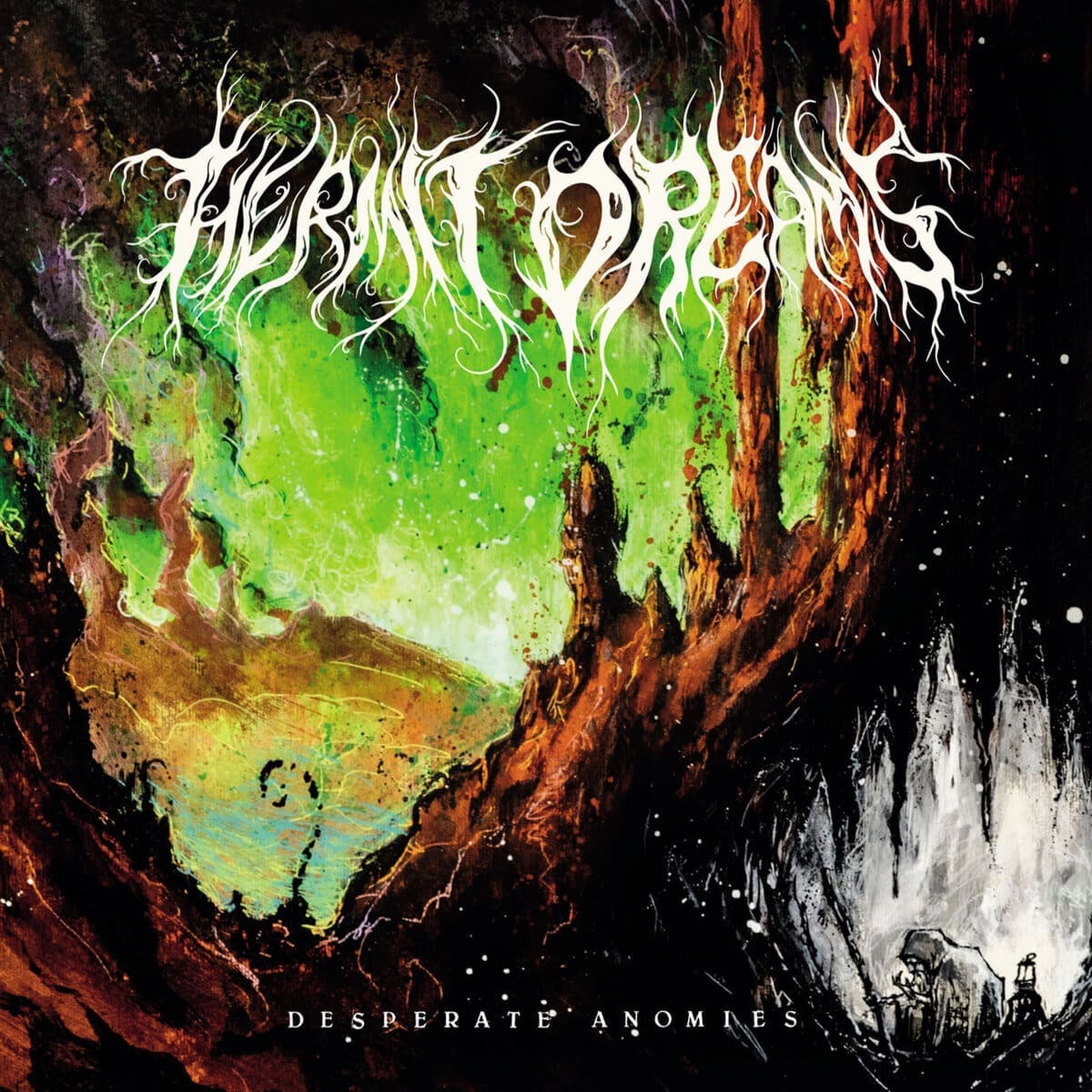
The artwork exists in a liminal space between decay and frost, where sound becomes ritual. It doesn’t scream; it groans — just like the funereal string voice.
The Seventh Sin, Disrelish
There is nothing to dislike within the musical offerings of Desperate Anomies. Hermit Dreams deliver a release forged in decay, darkness, and oppressive heaviness. Desperate Anomies does not ask for attention; it settles in and refuses to leave.
Promotional material provided by Chaos Records.
The Hymns
01. Trembling Heretic
02. Directionless Gaze
03. Reach for the Void in Despair
04. Den forgjengelige innsikt 05. Everlasting Mire
06. Lorn Apparition
07. Rastløshetens egenvekt
08. And Now What..?
Hermit Dreams
Martin Storm-Olsen — Banjo, GuitarsEyvind W. Axelsen — Cello, Upright Bass, Bass Guitars
Bjørn Tore Erlandsen — Drums
Eirik Waadeland — Vocals