Mascharat — Ars Aurea Mortis Review
Mascharat are an Italian black metal entity rooted in ritual atmosphere and alchemy-shaped darkness. On January 31st, 2026, the band unveiled their second full-length, Ars Aurea Mortis, released through Remparts Productions.
Mascharat, Ars Aurea Mortis Review: This review will evaluate every aspect of the album, from its intricate musical composition to its production.
The First Three Sins, The Summary
The First Sin, The Strings/Keys: Rather than yielding to chaos, the tremolo work sustains controlled melodic tension, balancing ritual intensity with deliberate structure. The Second Sin, The Vocals: The vocals do not sing; they invoke — blending harsh black metal rasps and snarls with controlled ritual presence. The Third Sin, The Percussions: The percussion remains disciplined and intentional. Blast beats arrive as surgical strikes rather than constant noise, giving way to measured ritual marches.
The Fourth Sin, Overall Discussion
Invocation of the Work
The first hymn, Intro, captivates as soon as you hit play. It is a haunting, two-minute drum invocation—a heart-pounding rhythmic ritual that serves as the gateway to the remaining seven hymns of Ars Aurea Mortis.
The Alchemical Framework
Within these hymns, Mascharat guides the listener through a masked journey rooted in Venetian esotericism. It is a work of classical transformation, thematically anchored in the weight of alchemy, literature, and the Ars Goetia. Each hymn feels less like a song and more like a stage in a transmutative ritual.
The four central hymns—Nigredo, Albedo, Citrinitas, and Rubedo— represent the four original stages of the transformation of matter, corresponding in alchemy to the processes of decomposition, distillation, combustion, and sublimation. Meanwhile, Intro and Outro, together with Re Mida and Lapis (the Stone), form the framework within which the initiatory quest takes place.
The Great Work in Motion
Mascharat delivers over forty-one minutes of alchemical black metal that consumes the listener. It is raw, dense, and symbol-driven—unsettling in its intensity, yet surprisingly atmospheric and melodic. There is no sloppiness here, nothing ornamental without purpose. Instead, the listener is rewarded with a highly structured composition and a deliberate arrangement that mirrors the precision of the Great Work itself.
Ritual Devilmanship
Mascharat’sdelivery is anchored by floor-to-stone devilmanship—a tight, disciplined arrangement where the music and instruments behave like stages in a Great Work. Each timbre is a reagent; each performance a transformation. The guitar work serves as the album’s spine: sharp and deliberately ritualistic. Rather than yielding to chaos, the tremolo lines favour a controlled melodic tension. The tone itself — a mid-gain black metal rasp — is never overly saturated, allowing the music to breathe through rhythmic shifts that oscillate between fast, ritual-pulse tremolo and mid-tempo, processional chords, punctuated by sparse, almost liturgical clean passages.
The guitars act like the alchemical fire: they initiate the transformation, scorch the material, and define the emotional temperature of each stage.
The percussion is controlled and intentional, successfully avoiding the blast beat wallpaper. Blasts are used as surgical strikes rather than constant noise, giving way to mid-tempo ritual marches. The cymbal work creates shimmering transitions between alchemical phases, while the snare tone remains dry, tight, and almost martial.
The Hidden Laboratory
The vocal performance avoids the trap of over-singing, opting instead for a narrative-driven balance.
Beyond the martial percussion and the rhythmic spine lies a haunting internal atmosphere. Mascharat abandons symphonic bombast, relying instead on compositional tension and the sparing use of clean acoustic piano and synth textures. It feels like a hidden laboratory: low-key ambient pads emerge during the intro and more reflective alchemical stages, leaning toward airy drones, subtle choral pads, and a faint metallic resonance—barely visible, yet essential.
They evoke a masked ritual unfolding in a dim, enclosed space where the air itself has become heavy with transformation.
The vocals do not sing; they cast spells. Each line feels like a ritualistic summoning, blending harsh black metal rasps and snarls with sparing, whispered passages used for chilling dramatic effect. The vocals embody the Alchemist—the central figure performing the transformation, invoking each stage of the work with a controlled intensity that avoids theatrical excess in favour of genuine occult authority.
Sonic Architecture
Mascharat aims for a sense of sonic architecture, like a stone chamber lit by a single, steady flame. Everything is audible; nothing is over-processed or suffocated by modern sterility. The record feels engineered to let the alchemical stages breathe, rejecting the typical wall-of-sound approach for a structured, breathable mix that allows the listener to hear the gears of Ars Aurea Mortis.
Extinguishing the Flame
The album closes with Outro, a final hymn that feels less like a cinematic epilogue and more like the literal closing of the laboratory. It is the sonic equivalent of extinguishing the single flame, covering the ritual instruments, and letting the volatile vapours settle into the stone.
The Transmutation Complete
Overall, Ars Aurea Mortis is a forbidden fruit of art—a fruit of sonic alchemy that flawlessly crosses raw black metal with ritual and occult depths. It is a disciplined, breathable descent into the Venetian shadows
The Fifth Sin, The Memorabilia
For me, Ars Aurea Mortis is not simply black metal; it is old-school yet melodic alchemy black metal, delivered with strong production and disciplined devilmanship. This is music for isolation — black metal to sit in a corner with, to let it possess the room, your ears, and your soul. I chose the extra sinner’s possession: headphones.
The Sixth Sin, The Artwork
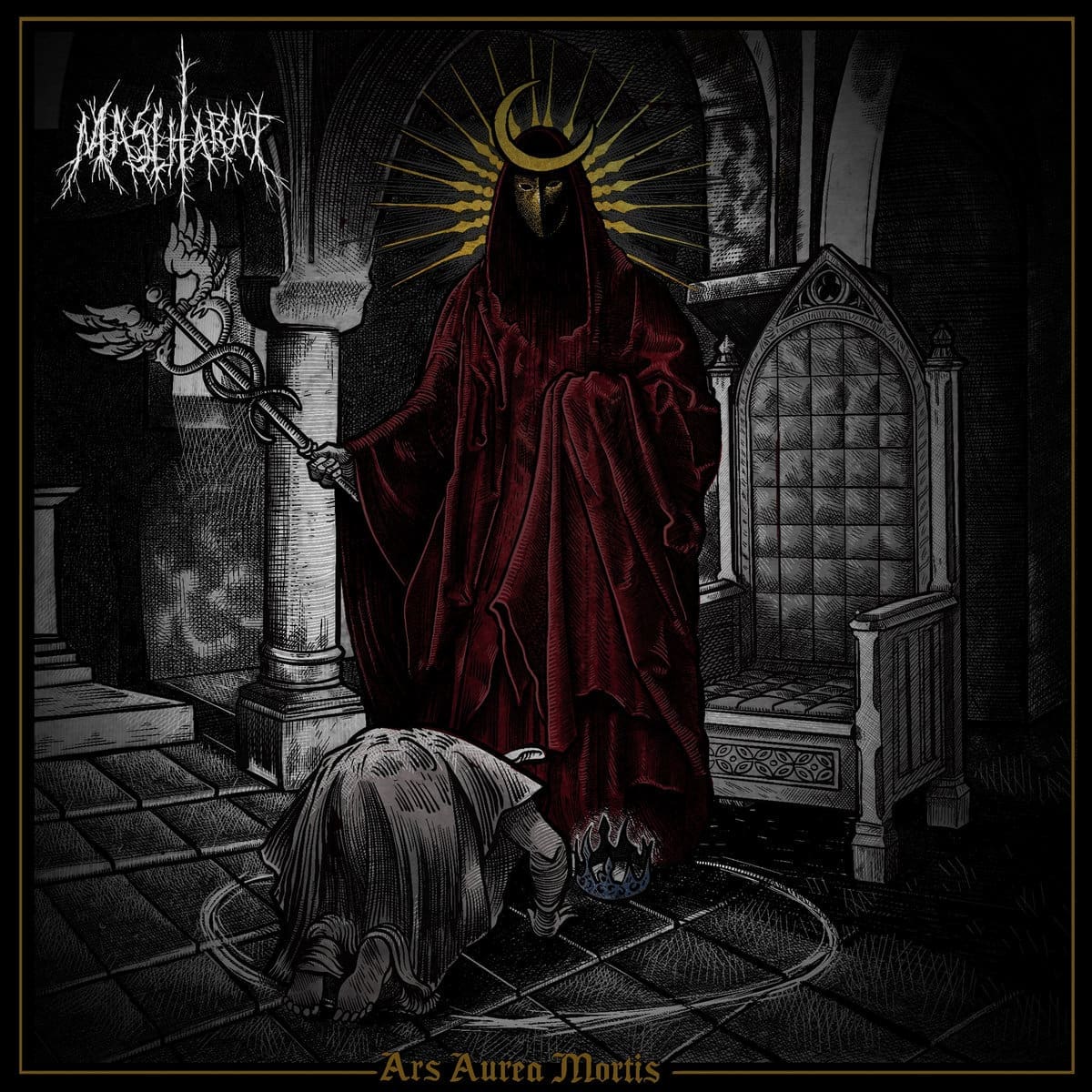
The artwork reflects the music’s alchemical and ritual themes — restrained, symbolic, and aligned with the album’s lyrical and sonic identity.
The Seventh Sin, Disrelish
There is little to disrelish here — a pure, dark forbidden fruit of art, shaped through ritual precision and deliberate transformation.
The Hymns
01. Intro
02. Re Mida
03. Nigredo
04. Albedo
05. Citrinitas
06. Rubedo
07. Lapis
08. Outro
Mascharat
Hellequin — Vocals, Gutiars
Grímr — Guitars
Stilleben — Bass, Effects
Cutiron — Drums
The members are anonymous