Mortgrim — Blasphemy Review
Mortgrim is a Hungarian solo black metal entity, operating as a one-man project. On 22 February 2026, Mortgrim released their independent debut full-length, Blasphemy.
Mortgrim, Blasphemy Review: This review will evaluate every aspect of the album, from its intricate musical composition to its production.
The First Three Sins, The Summary
The First Sin, The Strings/Keys: Chain-drag tremolo and mid-tempo weight — raw, friction-heavy riffs that balance aggression with doom-laden gravity. The Second Sin, The Vocals: Harsh, rasped proclamations — spiritually charged and direct, delivered with ritualistic conviction. The Third Sin, The Percussions: Dual-state drumming — blast-driven ferocity tempered by slow, deliberate pacing that reinforces the ritual’s weight.
The Fourth Sin, Overall Discussion
Opening the Infernal Gate
The moment the listener presses play, the opening hymn, In Nomine Satanae, greets them with a chilling juxtaposition: dark melodicism paired with a harsh, uncompromising vocal introduction.
This serves as the ritualistic gateway, immediately signalling that the listener has left the world of the living and entered a space of profound spiritual and physical weight.
Descent Through Brimstone & Weight
As the journey continues through the remaining five hymns, Blasphemy reveals its true, multifaceted nature. Across a compact twenty-minute runtime, Mortgrim seamlessly blends the frostbitten aggression of black metal with the slow heaviness of doom metal enriched by atmospheric veils and ethereal layers.
This is music that is not necessarily slow or fast in the traditional sense; it possesses a deliberate, agonising pace that makes the listener feel as though they are being dragged across the jagged brimstones of hell.
It is an endurance test — a short, sharp shock of infernal reality that leaves no room for light or sanctuary.
Invocation of the Adversarial Will
At its conceptual heart, Blasphemy is a solitary invocation of Luciferian will. This is a work steeped in Satanic philosophy and occult introspection, representing a cold, calculated rejection of divine order. Mortgrim treats blasphemy not as a superficial shock to the system, but as a deliberate spiritual stance: a turning toward the adversarial current that runs beneath the surface of consciousness.
Forged Devilmanship
Mortgrim provides the listener with a form of devilmanship that is solid and honed to perfection. The instrumental arrangements and overarching compositions are handled with a calculated maturity; nothing feels out of place, and nothing feels rushed. There is a sense of architectural stability here — a feeling that within every hymn, everything falls into its rightful place to serve the greater adversarial ritual.
Chain-Drag Riffs & Sonic Weight
The guitars act as the raw backbone of Blasphemy, built on a foundation of relentless tremolo picking and disciplined mid-tempo riff craft. Their movement is physical — they drag like heavy chains across the ground, providing a sense of friction and resistance that defines the album’s weight.
When the music accelerates, the tremolo becomes the primary carrier of the album’s rawness, sharpening into a serrated edge that cuts through the atmosphere. In the slow-burn of the lower tempos, the riffs introduce subtle melodic undertones that drift toward blackened doom, adding a layer of emotional gravity to the spiritual desecration.
Subterranean Pressure & Ritual Pulse
The bass, while not foregrounded, is unmistakable in its presence. It acts as the subterranean pressure in the doom-infused passages, ensuring the brimstone has a tangible, suffocating depth. The drums shift between two dominant modes, and the percussion dictates the ritual’s pace. It moves from blast beats and tremolo-driven velocity — fuelling the record’s raw ferocity — to slow, deliberate mid-tempo patterns that reinforce the doom-laden sections.
Proclamation & Spectral Veil
The vocal performance is harsh, rasped, and spiritually aggressive — a delivery that is fully aligned with the record’s core of Satanism, Luciferian philosophy, and blasphemy. These are not merely sounds; they are proclamations. To deepen the ritualistic tone, Mortgrim incorporates spoken-word passages, grounding the esoteric themes in a chilling, human reality.
It feels like a sermon delivered in an empty cathedral, where every word carries the weight of a deliberate spiritual rejection.
The spectral shroud of synths is used with surgical precision, appearing sparingly to shift the record’s emotional temperature. Rather than providing melody, they function as:
- Cold Pads: Layered behind the chain-drag guitars, expanding the sonic space.
- Thin Veils of Ambience: Creating a sense of distance and spiritual coldness.
In the world of Blasphemy, the synths never dominate; they haunt. Their role is to widen the void, ensuring the atmosphere feels vast and ancient without ever compromising the raw, serrated edge of the black metal foundation.
Raw Force, Controlled Clarity
The production of Blasphemy is heavy and raw, yet it avoids the murky pitfalls of traditional raw black metal. Instead, Mortgrim utilises a modern clarity that ensures every element of the devilmanship is felt with maximum impact.
The sound is characterised by:
- Weighted Presence: The guitars and bass carry a physical, crushing weight that anchors the listener in the brimstone.
- Atmospheric Depth: Sparse synth veils provide a sense of scale without obscuring the core aggression.
- Intelligible Ferocity: Even at high velocity, the tremolo lines and blast beats remain sharp and modern — proving that rawness is an intentional stylistic choice, not a technical limitation
Final Investment — Cathexis
The album reaches its inevitable end with the final hymn, Cathexis. This closing piece serves as the ultimate investment of psychic energy into the adversarial path. As the music fades, it leaves a lingering sense of completion — the spiritual stance has been taken, and the divine order has been successfully rejected.
After the Ritual — Ash & Silence
Overall, Blasphemy is a rotting and depressive fruit of art. By expertly mixing the ferocity of black metal with the suffocating weight of doom metal, Mortgrim has created something distinctly its own.
The Fifth Sin, The Memorabilia
For me, Mortgrim is something bold and apocalyptic. It is a rotting and depressive fruit of art because it skilfully blends the frost of black metal with the crushing weight of doom.
The entire twenty-minute runtime is saturated in depression, driven by a tempo that drags the listener through the dirt. There is even a hint of black ‘n roll here — reminiscent of Satyricon during their Now, Diabolical era — which gives the hymns a dark, infectious pulse.
The sparse synths add a final cosmic touch, and with the saturated atmosphere on top, making the music feel as though you are witnessing the world slowly and painfully burning to cinders.
The Sixth Sin, The Artwork
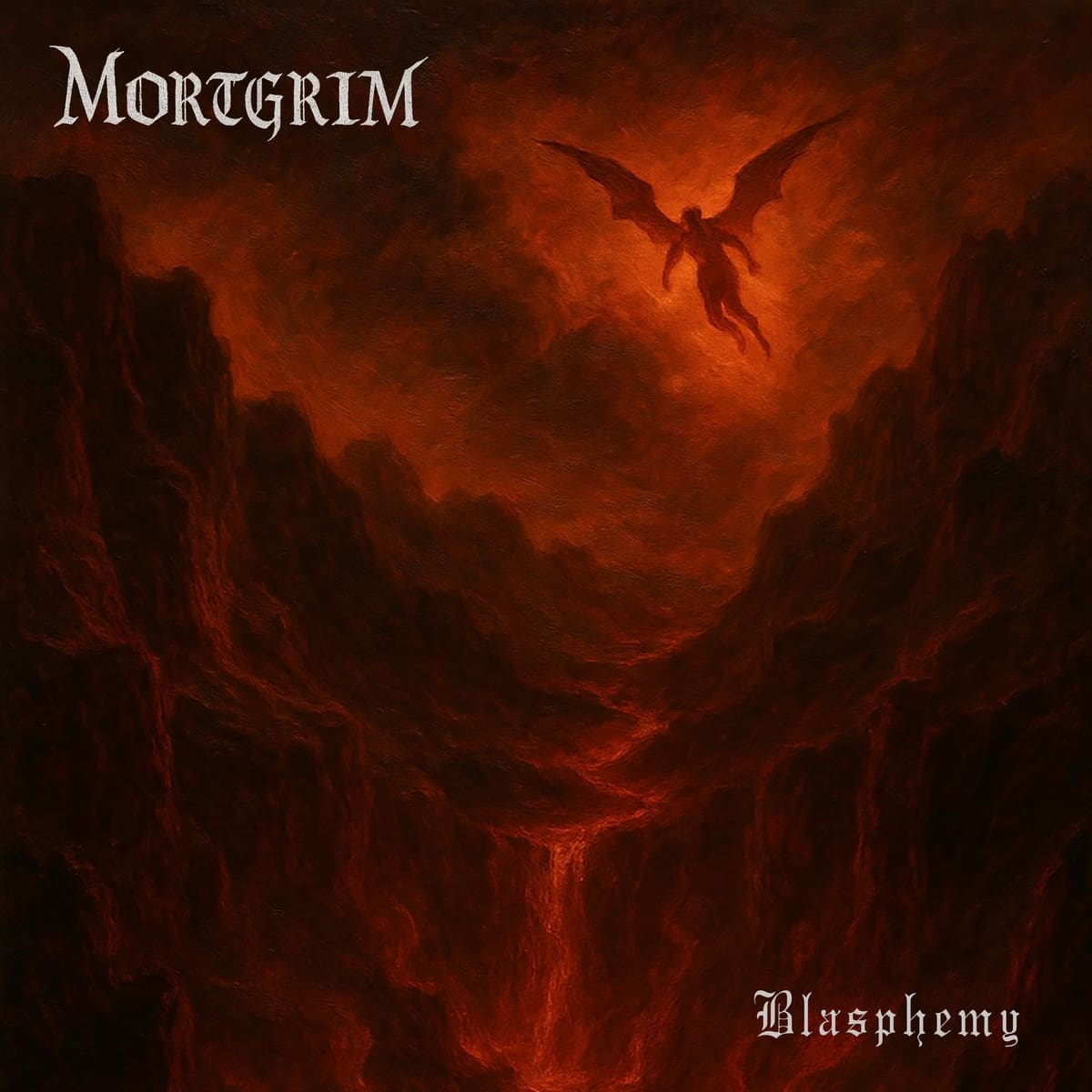
The artwork is both cosmic and apocalyptic. It serves as the visual realization of the album’s sound: a wide-angle view of the end of all things, captured in the cold vacuum of space and the heat of infernal liberation.
The Seventh Sin, Disrelish
There is little to disrelish within Blasphemy. It is a tight, disciplined, and unyielding piece of extreme art that accomplishes exactly what it sets out to do: destroy and liberate.
The Hymns
01. In Nomine Satanae
02. Lucifer Lux Aeterna
03. Blasphemy
04. Godless
05. Through Broken Gates
06. Cathexis
Mortgrim
Máté Nagy — Everything