Victims of Contagion — Egregore Review
Victims of Contagion are an American technical death metal entity who returned with their devastating second independent full-length, Egregore, on 25 September 2026, and promoted through Cutting Edge PR.
Victims of Contagion, Egregore Review: This review will evaluate every aspect of the album, from its intricate musical composition to its production.
The First Three Sins, The Summary
The First Sin, The Strings/Keys: Rapid-fire technical riffing, frost-bitten tremolos, neoclassical leads, subterranean bass grooves and subtle atmospheric synthesisers. The Second Sin, The Vocals: Chest-rattling guttural growls, piercing screams and dynamic extreme vocal transitions. The Third Sin, The Percussions: Hyper-fast blast beats, intricate double-kick patterns, polyrhythmic structures and relentless tempo shifts.
The Fourth Sin, Overall Discussion
The Threshold of Sonic Devastation
From the very second the listener presses play, Egregore extends a chilling invitation, drawing them into a dense, atmospheric soundscape that builds anticipation for the sonic devastation to come. Almost immediately, this haunting prelude shatters into an unyielding onslaught.
What follows from the mist of the atmospheric soundscape is a relentlessly brutal, highly technical display of composition that dominates the remainder of the opening hymn and bleeds seamlessly into the six monolithic hymns that follow.
Labyrinths of Technical Brutality
Clocking in at a relentless thirty-five minutes, the album forges a breathtaking synthesis of blistering, high-speed technical death metal and labyrinthine progressive arrangements. The devilmanship is as demanding as it is dazzling, seamlessly weaving neoclassical fretboard work and intricate rhythmic structures into compositions exploring lyrical themes of corrupt authority, animal exploitation, conformity, military propaganda, destructive parental relationships and personal regret.
Furthermore, despite flitting with occasional atmospheric textures and bleak blackened guitar passages that evoke a chilling sense of dread, Egregore firmly roots its identity in the realm of modern progressive technical death metal. It consciously bypasses the clichés of symphonic, melodic, or blackened death metal, choosing instead to prioritise clinical precision, avant-garde structural unpredictability, and a razor-sharp contemporary edge over overblown orchestration or genre-standard tropes.
The Ironclad Discipline of Devilmanship
The composition and devilmanship of Egregore are honed to perfection, radiating a sense of ironclad discipline where every element feels tight and under control. This skill extends far beyond mere structural composition; it governs the punishing speed, melodic leads and atmospheric passages with surgical precision — everything has a place and every timing cue is executed with lethal accuracy.
Even as a brutally technical soundscape rattles relentlessly through your eardrums, astonishingly, no two hymns ever bleed together or feel rushed, maintaining a dynamic tension from the first hymn to the last.
Frost-Bitten Strings & Neoclassical Warfare
At the heart of this sonic assault is the twin guitar attack wielded by Chuck Forsythe and Tony Zello. Together, they forge a seamless fusion of rapid-fire technical death metal riffing and icy, frost-bitten tremolo-picked passages. Their songcraft effortlessly bridges progressive and polyrhythmic arrangements with neoclassical lead work, frequently erupting into intricate lead harmonies and melodic lines.
Furthermore, the listener is treated to stark acoustic interludes, blackened passages and elaborate interplay between the guitars. Within the walls of riff-craft, echoes of influence emerge yet are fiercely synthesised: one can trace the dark, majestic atmospheres of early Dimmu Borgir colliding head-on with the earth-shattering, heavier grooves of Gojira.
Subterranean Rhythms & Guttural Torment
Beneath this towering dual-guitar onslaught, bassist Robert Geisler anchors the turbulence, carving out subterranean dark passages that shadow and amplify the twisting movements of the fretboard with unwavering heaviness. Drummer Mike Rush acts as the relentless engine, driving the compositions forward with hyper-fast tempos and complex polyrhythmic arrangements.
Mike Rush’s effortless shifts in time signatures provide a fluid foundation that supports technical movements, bone-crushing heavier rhythmic passages and fast blast beats, through to thunderous, intricate double-kick work that anchors the chaotic atmosphere.
At the forefront is vocalist Chris Edison, whose voice operates as a dynamic, chameleon-like force. Edison effortlessly traverses the extreme vocal spectrum, moving seamlessly between chest-rattling guttural growls and spine-chilling piercing screams — functioning almost as an additional instrument within the arrangements.
Electronic Shadows & Unorthodox Devilmanship
Beyond the sheer aggression of the primary instrumentation, Egregore incorporates a subtle electronic layer. Synthesisers are utilised — but do not appear to function the way they would in symphonic death metal or black metal. Instead, they serve more as atmospheric and textural undercurrents that amplify the tension and reinforce the song’s technical death metal framework.
Further elevating the composition is an exceptional guest appearance by former Megadeth axeman Chris Poland. Lending his signature, highly distinctive touch to the second hymn, Forced March, Poland infuses the brutal extreme metal landscape with his unmistakable jazz-influenced phrasing, creating a striking stylistic juxtaposition that expands the boundaries of the hymn.
Overall, Egregore is a technical and cohesive fruit of art, where skipping a hymn is simply not an option.
The Fifth Sin, The Memorabilia
Victims of Contagion are, in my opinion, the perfect example of death metal — rapid, brutal, extremely technical, and surprisingly progressive. Across the album, the band embraces long, winding compositions that allow each song to establish its own distinct identity. Despite the extended runtimes, the music never feels dull or repetitive; instead, it is overflowing with character and dynamic shifts.
What truly elevates the experience — beyond the flawless devilmanship — is the vocal delivery, which seamlessly alternates between guttural growls and piercing screams. Comprising seven substantial hymns, the album offers more than enough meat to sink your teeth into.
While Egregore is undeniably designed to ooze out of your speakers at maximum, neighbourhood-shattering volume, the mix is intricate enough to be thoroughly enjoyed through a pair of high-end headphones. It reveals subtle layers of technical wizardry that might otherwise get lost in the onslaught.
The Sixth Sin, The Artwork
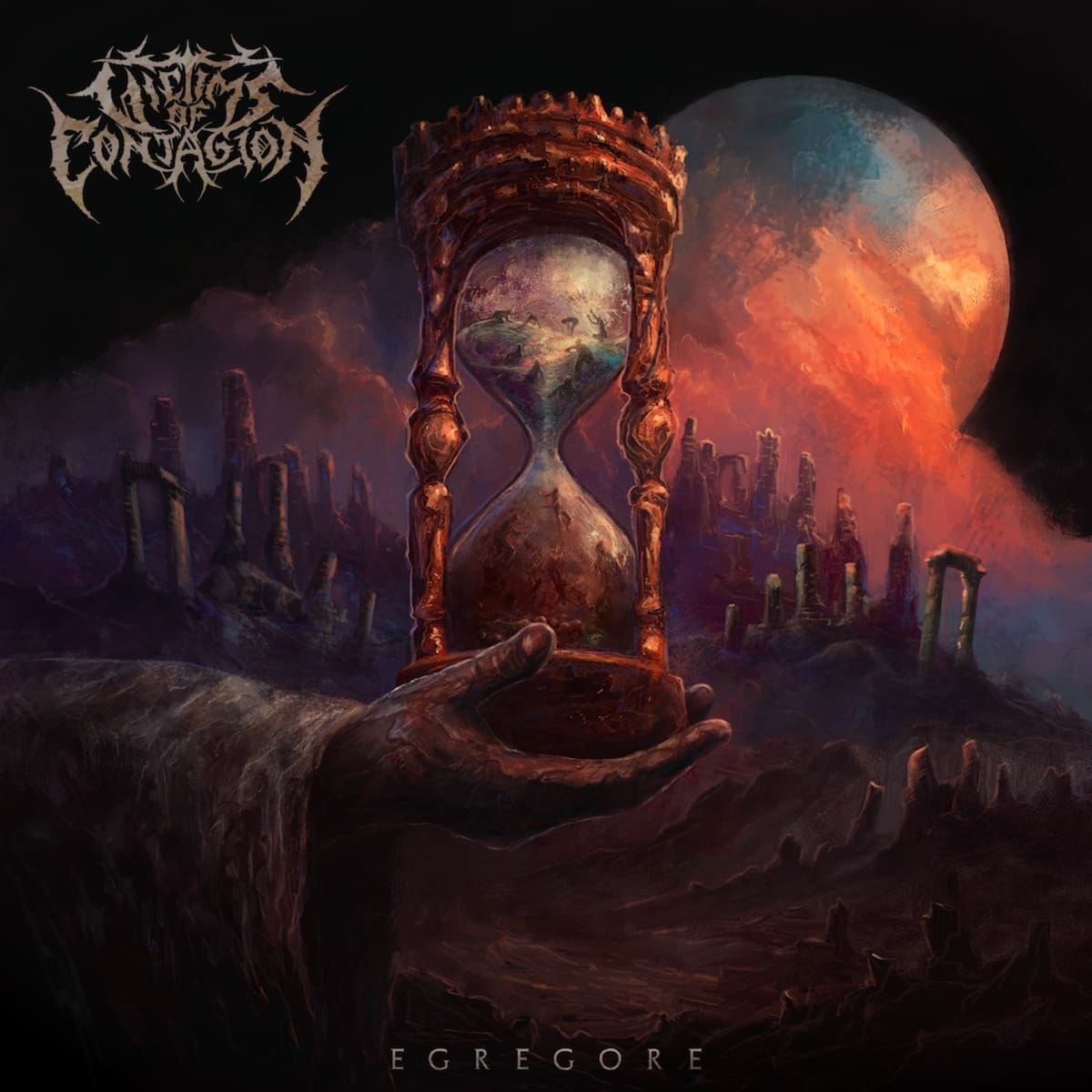
The album’s physical presentation matches its sonic weight. The artwork features striking apocalyptic imagery, dominated by a looming, blood-red moon overlooking a decaying civilisation. This visual instantly sets the tone, capturing the album’s core themes of systemic corruption, profound suffering, and inevitable consequence.
The Seventh Sin, Disrelish
Yet, when one steps into the experience crafted here, the sheer atmosphere pulls you into a delightful paradox: there is very little to dislike here.
The Hymns
01. The Anointed
02. Forced March
03. Ignoble Sin — The Searing Pain of Introspection
04. A Conscientous Objection
05. The All Devouring Mother
06. Saturn (The Usurper)
07. 1123(4)5
Victims of Contagion
Mike Rush — Drums
Chris Edison – Vocals
Tony Zello – Guitars, Synthesisers
Chuck Forsythe – Guitars, Synthesisers
Robert Geisler – Bass
Chris Poland – Guest Guitar
Hear The Music
Social Links
Victims of Contagion | Facebook