Wakas — Real Final Review
Wakas is a Peruvian heavy metal entity. Their latest independent full-length, Real Final, was released on 4 January 2026.
Wakas, Real Final Review: This review will evaluate every aspect of the album, from its intricate musical composition to its production.
The First Three Sins, The Summary
The First Sin, The Strings/Keys: Galloping heavy metal riffs form the backbone of the faster sections, while the doom passages rely on descending minor-key progressions. The Second Sin, The Vocals: A high-pitched rasp punctuated by falsetto spikes. The Third Sin, The Percussions: The drumming is unpretentious, grounded, and inherently ritualistic; it is not a display of technicality, but an anchoring of the rite.
The Fourth Sin, Overall Discussion
El Señor de los Báculos — The Summons
The journey begins as El Señor de los Báculos emerges, greeting the listener with heavy instrumentation and chest-pounding vocals, building a relentless momentum for what is about to be unleashed. This opening hymn doesn’t simply begin the album; it acts as a summons.
There is a primitive, ancient power in the way the riffs ground themselves, preparing the senses for a descent into the myths and battles of the Inca civilization.
Inca Metal Doctrine
Real Final continues with its six remaining hymns, maintaining a focused run-time of under thirty-five minutes. Across this span, the classic heavy metal foundation begins to warp; the vocals transform into a blackened, hoarse rasp, pulling the music into a darker, more interdimensional space. This transition is layered over a dense, doom-laden sound, utilising the rich themes of Inca culture to ground the production in something ancient and mystical.
It is a sonic ritual that feels both primitive and expansive, moving beyond standard genre boundaries.
Muerte en la Horca — The Mystic Centrepiece
The third hymn, Muerte en la horca, stands as the album’s longest and heaviest centrepiece at seven minutes. It is here that a mystical symphony is introduced, and the fundamental magic of the record reveals itself; the initial peace is shattered as the hymn transitions into a heavy, blackened composition — reminiscent of Diamond Head’s Am I Evil blended with the epic density of Candlemass.
It is slow, evil, and hypnotic—a soul-crushing progression where the vocals sharpen the atmosphere into something truly sinister.
This flows directly into the fourth hymn, Invocación del Ukhu Pacha, which operates largely as a heavy metal instrumental. The sparse, harsh incantations spread across the hymn enhance the feeling of a ritual invocation, making those few lines feel like guttural whispers echoing up from the underworld.
Devilmanship in Andean Steel
Wakas exhibits a tight devilmanship, characterized by colourful composition and a rich instrumental palette. Within this structure, the guitars act as the primary carriers of the album’s ceremonial weight. While operating with a classic twin-guitar formation, the execution leans heavily toward a distinct South American heavy/doom dialect rather than typical NWOBHM flash.
Galloping heavy metal riffs form the backbone of the faster sections, while the doom passages rely on descending, minor-key progressions that feel both ritualistic and oppressive. Harmonized leads appear sparingly, yet when they do, they echo the phrasing of early South American metal — melodic but slightly jagged, maintaining a sharp, ancestral edge.
Ritual Percussion & Keyboard Veil
The drumming on Real Final is unpretentious, grounded, and inherently ritualistic; it is not a display of technicality, but an anchoring of the rite. The production favours a natural room tone with minimal compression, allowing the snare to maintain a dry, old-school papery crack, while the low-tuned toms provide the doom sections with a sombre, funeral-march resonance.
Keyboard sections are placed with careful restraint. They never overpower the composition, instead providing atmospheric pads and ritual-styled textures that weave melodic accents tied to Andean mythic themes into the metal foundation.
Above this foundation, the vocals deliver a high-pitched rasp punctuated by falsetto spikes—a raw, unrefined timbre that feels closer to the spirit of early South American heavy metal than polished European doom. These are occasionally traded for harsh incantations—particularly in the fourth hymn—which serve as ritual utterances rather than traditional lyrical lines.
Raw Ceremony, Unpolished Power
The overall sound retains a heavy metal core reinforced by significant doom metal weight, while the production carries the raw, earnest character typical of self-released South American metal. The mix deliberately prioritises the guitars and vocals, leaving the drums slightly recessed and the bass present without being dominant; this creates a guitar-forward wall of sound that is perfectly consistent with the band’s primitive style.
By avoiding over-polish, the production allows the edges to remain rough, granting the album a live, ceremonial energy. It feels less like a product of a modern studio and more like a captured moment of a band performing a ritual in a space where the air is thick with history.
Cahuide el Guerrero — The Final Sacrifice
The album closes with Cahuide el guerrero, a hymn that serves as a final, heavy doom sacrifice. There is a palpable invitationto the darkness here, a sense of falling into the void of history with a warrior’s dignity. As the final notes of this epic conclusion ring out, the weight of the Ukhu Pacha (the underworld) lingers in the room. It is a powerful end that doesn’t just stop—
Legends in Distortion
The thematic journey through Real Final is inseparable from its sonic weight, where the mythic narratives of the Inca aren’t just lyrics, but the very pulse of the music. By the time the listener reaches the middle of the record, theInca Metal identity has fully taken hold, blending the historical pride of the Andes with the crushing hopelessness of traditional Doom.
This is a history lesson; it is a spiritual immersion. The band succeeds in making the ancient past feel present, utilising the South American heavy/doom dialect to translate legends of war and gods into a language of distortion and grit.
The Fifth Sin, The Memorabilia
For me, Real Final is a solid fruit of art. It is a rare example of a band successfully carving out a regional identity within the Doom and Heavy Metal framework. I found that the ceremonial energy of the record offered exactly the kind of other-dimensional experience I look for in South American metal — raw, honest, and heavy.
The third hymn, Muerte en la horca, came as a particular favourite of mine, serving as the definitive moment where the album’s mystical and crushing elements collide.
The Sixth Sin, The Artwork
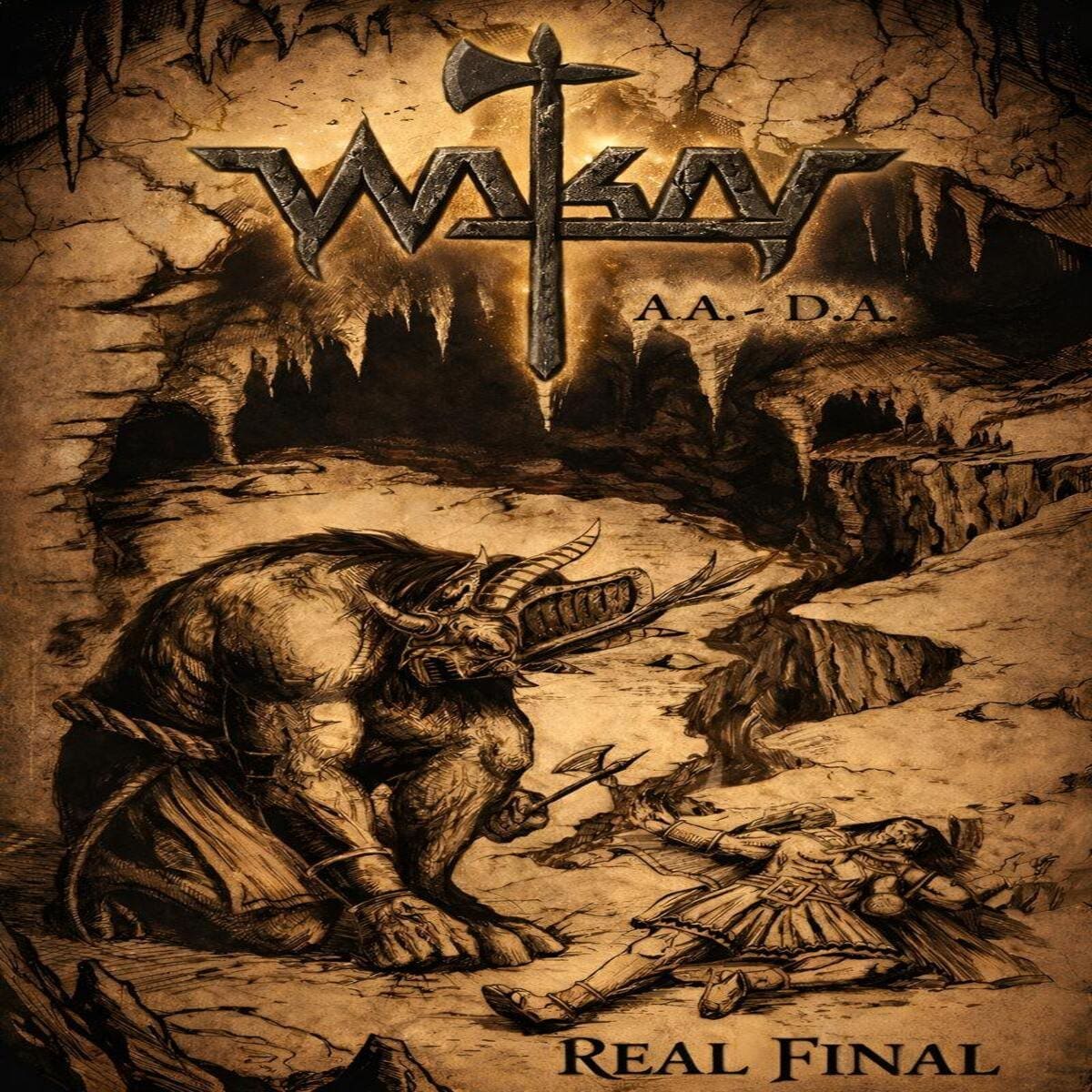
In the artwork, suggesting ancient parchment or a dusty cave wall, the illustration depicts a monstrous, horned beast — perhaps a guardian of the Ukhu Pacha — looming over a fallen warrior within a cavernous landscape.
The Seventh Sin, Disrelish
There is little to disrelish for those who value raw, honest devilmanship over sterile modern production. Some listeners might find the guitar-forward mix and slightly recessed drums a hurdle, or the hoarse vocal transitions an acquired taste, but these elements are essential to the album’s live, ceremonial energy.
Promotional material provided by Wakas.
The Hymns
01. El señor de los báculos
02. La llegada de los falsos Dioses
03. Muerte en la horca
04. Invocación del Ukhu Pacha
05. Sagrado funeral
06. Desafiar a Supay
07. Cahuide el guerrero
Wakas
Siniestro — Vocals
David Mendez — Guitars
Raúl Álvarez — Guitars
Giorgio Gutiérrez — Drums
Yavet Acuna — Keyboards (collaboration in El señor de los baculos)
Rene Pacheco Pacheco & Clarisa Lopez — vocals on Invocación del Ukhu Pacha