Tragos — Bellicum Review
Tragos is a French old school death metal entity. On 13 March 2026, the band released their debut full-length Bellicum via Fetzner Death Records.
Tragos, Bellicum Review: This review will evaluate every aspect of the album, from its intricate musical composition to its production.
The First Three Sins, The Summary
The First Sin, The Strings/Keys: Neoclassical riff-craft fused with old-school death metal brutality — rapid scalar runs, counterpoint-driven phrasing, and Baroque structures embedded directly into the guitar work. The Second Sin, The Vocals:Deep, cavernous growls rooted in traditional death metal — punctuated by sharper snarls that inject urgency, grounding the technical precision in primal force. The Third Sin, The Percussions: Disciplined, functional drumming — blast beats and mid-tempo strikes acting as a stabilising backbone, supporting the intricate guitar architecture without excess.
The Fourth Sin, Overall Discussion
Movement I — The Opening Overture
As soon as the listener presses play, the opening hymn, Lethal Suspiro, greets them with a deceptive, classical elegance. This introductory grace quickly fractures, transitioning into a dense and complex progressive-neoclassical death metal composition.
It is an opening that demands immediate attention, signalling that Bellicum is not merely an assault, but a highly technical and orchestrated manoeuvre.
Movement II — Theatre of Torment
As the journey deepens through the remaining eleven hymns, Bellicum reveals itself as a carefully constructed map of human torment. Each hymn serves as a study in a different shade of suffering: from the tragic sacrifice of Lethal Suspiro to the cosmic vanity found within the Narcissus Vortex.
The listener is dragged through the abyssal horror of Chthonian Exult, the morbid carnality of Sanguinolent, and finally, the splintering madness of the ego in Egofabulist.
This is not merely an album of aggression; it is an inner battlefield where the foundational pillars of faith, reason, flesh, and nothingness collide. Bellicum possesses a rare intensity that successfully restores death metal to a tragic and erudite dimension. It exists perpetually in that tensioned space: between the elegance of the classical and the brutality of chaos.
Bellicum is an exhilarating alchemy — a violent collision where the savage slaughter of old-school death metal meets the rigid elegance of the Baroque guitar tradition. It draws direct inspiration from the works of Matteo Carcassi, Fernando Sor, Scarlatti, and Bach.
Movement III — Doctrine of Composition
This is a vital distinction for the listener: this is not symphonic death metal. While many peers lean on the cinematic bombast of orchestral layering, Tragos integrates classical composition directly into the riff-craft itself. The hymns are not decorated by strings; they are structured by the logic of the masters.
Additionally, Bellicum carries the relentless intensity of Fleshgod Apocalypse and the historical weight of Ex Deo, yet the melodic phrasing is sharpened by the grim, blackened edge of early Necrophobic.
Movement IV — Counterpoint of Violence
The devilmanship of Bellicum is anchored in a stone-fixed precision, where the instrumentation and composition are inseparable. At the heart of the album lies a Baroque counterpoint turned violent — it is the ghost of Bach played through a buzzsaw-like instrument.
The guitar work is defined by relentless scalar runsreminiscent of classical guitar études, utilising arpeggiated chord shapes lifted directly from the techniques of Sor and Carcassi. This is not mere speed for the sake of brutality; it is a calculated, technical architecture.
Supporting this complexity, the bass guitar is felt before it is heard — a subterranean force that reinforces the rapid harmonic shifts, ensuring the neoclassical elegance never loses its terrestrial, death metal weight.

Movement V — Discipline & Flesh
The drumming is a demonstration of functional discipline. Intentionally non-flashy, the percussion cedes the stage to the guitar’s complexity, acting instead like a military snare corpspositioned behind a baroque ensemble. It is a performance defined by a strict, driving, and ceremonial intensity — shifting between fast, ripping blasts and heavy, mid-tempo stomps.
Providing the vital animalistic counterweight to this classical elegance are the vocals. Rooted in pure old-school death metal, they deliver deep, cavernous growls punctuated by occasional higher snarls.
This vocal presence ensures the inner battlefield feels populated by flesh and blood, preventing the album’s erudite dimension from ever losing its primitive, savage power.
Movement VI — Ossuary Acoustics
The production achieves a rare clean-raw hybrid aesthetic. It sounds like a world-class baroque ensemble trapped inside an ossuary, forced to play through thick distortion and bone dust. This modern yet organic sound preserves the raw, visceral power of the death metal foundation while ensuring that every intricate detail of the counterpoint finds its rightful place.
Movement VII — The Baroque Cycle
Bellicum does not feel like a mere collection of hymns; it is a cycle of twelve baroque symphonies. Each one is violent, ornate, and architecturally precise. It is a work that feels profoundly composed, not assembled — a singular, baroque fruit of art.
Bellicum feels composed, not assembled. The opening, Lethal Suspiro, a baroque overture turned violent — rapid scalar runs, sharp rhythmic stabs, a sense of ceremonial opening. The second hymn, Fragmento Fugit is more frantic, almost fugue-like — guitars chasing each other in counterpoint, the third hymn, Penumbra Prolix, darker, more shadowed — a sense of creeping dread.
The fourth hymn, Narcissus Vortex, reflective but savage — melodic phrasing twisted into something self-devouring, the fifth hymn, Labor Delusiv, short, sharp, almost étude-like — a technical burst. The sixth hymn, Scherzo Patibul,adance of the gallows — playful in structure, deadly in tone.
Movement VIII — The Ninth Curse
The seventh hymn, Chthonian Exult, the most subterranean hymn and the album’s abyssalhorror— heavy, ritualistic, earth‑bound. The eighth hymn, Random Punishment, is chaotic, violent, deliberately unhinged.
The ninth hymn, Ritual Deflor, the album’s rupture point. Ceremonial pacing, baroque ornamentation, a sense of initiation.
The curse of the ninth is the old belief that composers who reach their ninth symphony are doomed; this feels like the album’s dark centre, the point where the baroque elegance collapses into something primal and violent.
The tenth hymn, Sanguinolent, embodies the album’s morbid carnality. Blood-warm, aggressive, with classical phrasing peeking through the violence and the eleventh hymn, Egofabulist — the album’s madness of the ego. Grandiose, self-mythologising, almost triumphant.
Finale — Opus Carnifex
And finally, the closing hymn Opus Carnifex functions as a baroque coda — resolving the album’s harmonic tension.
The Fifth Sin, The Memorabilia
For me, Bellicum goes beyond the boundaries of old-school death metal, systematically breaking every law and code of the genre — and doing so with a visionary quality. Upon hearing the opening, I was expecting another exercise in symphonic bombast, but that assumption was quickly dismantled.
Instead, the guitars are allowed to breathe as Scarlatti and Bach, moving through the mix like a solemn, high-velocity procession. It is a profound shift for the genre; here, death metal takes on an entirely different shape, both in its musicality and its architectural composition.
The Sixth Sin, The Artwork
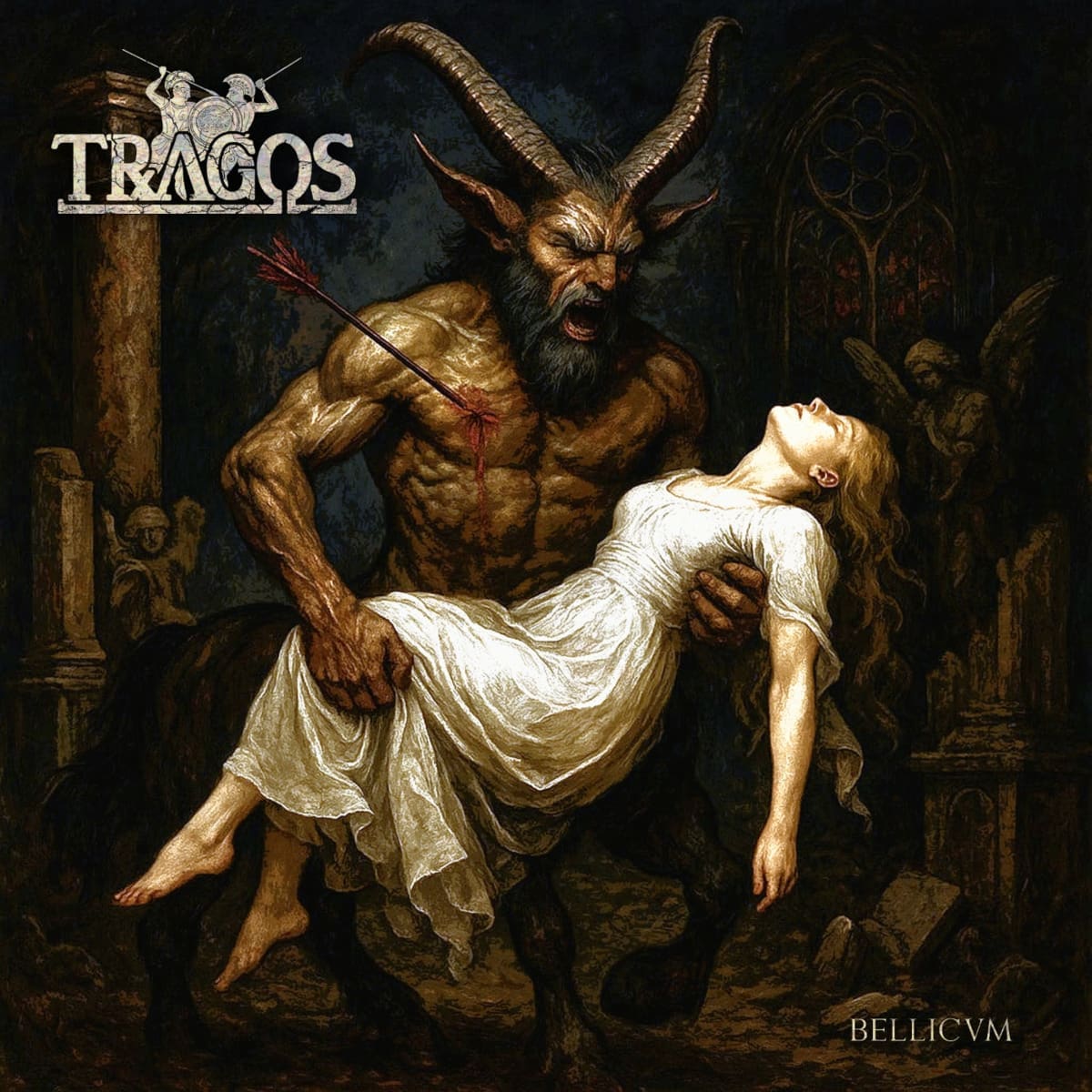
The artwork captures the entire classical and lyrical theme of the record — a visual representation of the Bellicum spirit that is as refined as it is violent. It is the face of the Erudite Fruit, balanced perfectly between the museum and the slaughterhouse.
The Seventh Sin, Disrelish
There is undoubtedly nothing to disrelish here. The record stands as a flawless monument to technical and creative transgression.
The Hymns
01. Lethal Suspiro
02. Fragmento Fugit
03. Penumbra Prolix
04. Narcissus Vortex
05. Labor Delusiv
06. Scherzo Patibul
07. Chthonian Exult
08. Random Punishment
09. Ritual Deflor
10. Sanguinolent
11. Egofabulist
12. Opus Carnifex
Tragos
François Delmont — Bass
Cédric Peresse – Guitars
Laurent Boyard – Drums
Kev Boomer – Vocals
Hear The Music
Social Links
Fetzner Death Records | Home Page
Fetzner Death Records | Facebook