A Sow of Violence Interview
The Interview — A Sow of Violence: Beauty, Dissolution, Narrative, & The Almighty Riff
A Sow of Violence is the solo extreme-metal entity of author and multi-instrumentalist Jason Korolenko. Across a growing body of work, the entity has developed a distinctive identity where extreme metal, atmosphere, storytelling, and contrasting emotions converge.
This interview explores the creative world behind A Sow of Violence. Across thirteen questions, we journey through its origins, creative independence, relationship between music and storytelling, The Unravelling, Sleeping with Flies, and the path that lies beyond.
Thirteen Questions constructed through beauty, dissolution, narrative, & existential unravelling.
Q1: For those encountering A Sow of Violence for the first time, who are you, where are you from, and what is the entity behind the name?
ASOV: A Sow of Violence is a solo passion project that slowly dragged itself from a bloody womb in 2020. I’d been recording and playing in bands for years, but music had kind of taken a back seat while I was writing books. I published a few novels, a book about Sepultura, a bunch of journalistic articles about metal and musicians, album reviews, short fiction.
Prior to lockdown, I’d been living in the wintry landscapes of northern New England for twenty-plus years, and when it all came crashing down, I suddenly found myself stranded in sweltering southern Florida during a global pandemic with just a guitar and a laptop. I started writing Chaos Breeds Beauty for fun, and then I found a note from 2006 I’d put down in my phone that read only, “A feral pig trotted into a church and declared itself a sow of violence.”
Since then, I’ve released three EPs, a standalone single, and a full-length album under the name A Sow of Violence. There’s no looking back now. That feral child that clawed its way into the world is now a toddler ready to take a bite out of some ankles.
Q2: A Sow of Violence draws inspiration from 90s death metal, second-wave Scandinavian black metal, English doom, and atmospheric post-genres without explicitly belonging to any one of them. How did these different foundations come together to form your own musical identity?
ASOV: Questions about genre and influence are always difficult for me because ultimately I feel ASOV is a subconscious representation of everything that I love in music, or at least everything I like to hear. On any given day, Type O Negative is probably my favorite band of all time, but you may only catch a glimpse of that influence in the music. I sometimes start a project thinking it will naturally sound most like whatever I’m listening to at the moment. That rarely happens, actually.
Lately, I’m listening to a lot of Man of Sorrows (a funeral doom project from Brazil), and every now and then I get the urge to write a funeral doom album. I may even begin writing with those intentions. But then a thrashy riff like “So Low” will materialize from the ether and all of a sudden the funeral doom idea goes out the window.
That’s why it’s so hard for me to describe ASOV in terms of soundalike bands or “For Fans Of…”. I take so much inspiration from so many sub-genres of metal that it’s impossible to detach and listen subjectively. I really have no idea who we sound like.
Q3: As a solo entity, you have complete control over everything from crushing death-metal riffing to atmospheric and cinematic passages. Does that freedom make experimentation easier, or does working without other musicians to challenge your ideas sometimes make composition more difficult?
ASOV: Definitely easier. Playing in bands is fun for what it is, but I have a tough time relinquishing any kind of control over what I create. I never wonder or have an impression that a song could potentially become better with someone else’s input simply because the song is always exactly what it is and should be. This might sound a little esoteric, but really it’s just about finding that point where you stop making a song better and start making it different. When it comes to my own work, I’ve found that collaborating with other musicians doesn’t necessarily make the song better, it just makes the song different.
That said, the primary appeal for me as a solo artist is the freedom to work whenever and however I want. I’m not waiting on a lyricist to become inspired or a drummer to get free time from their day job. I don’t have to book studio time based on someone else’s schedule. I create on my own time and throw the work into the abyss when it’s done. I gratefully accept praise for every success, and with equal grace take the blame for every failure. And then I move on with one goal: create something better than what came before.
Q4: On A Vow of Silence, I found an unspoken tension between beauty and decay — ethereal harmony repeatedly colliding with overwhelming dissonance without ever truly resolving. The Unravelling appears to continue that relationship through beauty and suffering. Is that contradiction something you consciously seek when composing A Sow of Violence, or does it emerge naturally from the subjects you explore?
ASOV: A little bit of both, probably. Even a glimpse of beauty can be euphoric when it follows a period of intense suffering. That idea is even embedded in the name, A Sow of Violence, which is obviously a play on “a vow of silence.” These opposing forces, silence and violence, chaos and beauty, the light and the dark, they’re all necessary elements of life. And I’m much more intrigued by exploring contrasting emotion than focusing on one specific feeling for an entire album, or even a single song.
Q5: Your background as an author seems to surface in the way A Sow of Violence develops atmosphere almost narratively, with compositions unfolding more like chapters than isolated hymns. When writing music, do you think in terms of narrative progression — tension, development and resolution — in much the same way you might approach written fiction?
ASOV: Yes, definitely. I’m always thinking in terms of narrative. The story is everything, whether I’m writing a book or a song. Ideas are great, riffs are great, but a great idea doesn’t automatically translate into a great story. If I’m writing a horror novel, for example, not every chapter is going to be horrific. That’s not the way narrative structure works and it’s not an accurate representation of life either. I think of my music in a similar way. And with The Unravelling, I actively wrote it sequentially the same way I would approach a novel.
For Those Who Travel with Ghosts builds the world and sets the atmosphere, Sleeping with Flies introduces emotional tension, So Low digs deeper into that tension revealing internal flaws, setting the stage for growth and character development, and finally, Retreat and Find Hell offers a sort of resolution, as ambiguous as it may be.
Q6: The Unravelling is summarised through six words: “all things exist to fall apart.” What does that statement represent to you, and how deeply does the idea of dissolution run through the EP?
ASOV: This EP as a whole was built around the theme of aging, the passing of time, and the psychological concept of unravelling. That age where you start to feel like there are more years behind you than ahead of you. You find yourself attending more funerals than weddings. Maybe you have kids but they have grown up and moved out. You’re too young to retire but starting to feel too old to enjoy many of the things you did when you were younger. It’s similar to that concept of the midlife crisis, and mostly experienced by men, except it doesn’t involve quitting your day job, buying a sports car, getting a side-piece and an earring, and growing out what little hair you have left.
So The Unravelling is essentially an exploration through existential crises and a journey down the slope of what they call “the happiness curve,” which is this strange phenomenon wherein people seem to become less happy even as their circumstances improve with time. But as I mentioned before, and as with many a great story, the ultimate outcome is up to the listener. Do you use this feeling of falling apart as a catalyst for healing, to put yourself back together and build something stronger? Or do you succumb and wallow and become one with the fray?
I know what it means to me, but I try to write the lyrics in a way that the listener can decide what it means for them.
Or maybe you don’t care about any of that, you just want to bang your fucking head to that nasty breakdown. That’s good, too.
Q7: Sleeping with Flies explores acrophobia through the oppressive question, “Where do you go if the only way is down?” Why did acrophobia become the vehicle for exploring anxiety within this hymn, and how did you translate that sensation of height, fear and inevitable descent into sound?
ASOV: I travel a lot for work. There’s a bridge between my house and the airport called the Skyway Bridge, and since I’m usually flying red-eyes, I cross the bridge mostly at night. It’s a very steep incline and decline, and at its apex sits around 60 meters over the Tampa Bay. As you approach the peak at night, your eyes are drawn to the blackness beyond the edge and you know it’s all water below as far as you can see even though you can’t really see it.
You don’t want to look but you can’t look away. It’s oppressive and terrifying, impressive and overwhelming, and I always find myself driving that bridge with my breath held and a feeling as if I’m drifting…
People who suffer from acrophobia often express that the true fear is a feeling that if they get too close to the edge, they will jump. It’s a completely nonsensical urge, but there it is. You fear heights not because you’re afraid of falling but because you’re afraid you will want to jump. I don’t have a fear of heights, but when I’m on that bridge at night, man, I get it.
And it worked with the overall concept of the EP, as if you’ve hit the peak of life feeling like it’s all downhill from there. This leads into So Low, the endless bottom of your fall, and then Retreat and Find Hell which, depending on your perspective, is either about laying down to die or crawling your way back up into the light.
Q8: Violins sit alongside off-kilter riffing and harsh vocals throughout Sleeping with Flies. When introducing an instrument associated so strongly with melancholy and beauty into extreme metal, how do you prevent it from becoming mere decoration and instead make it an essential part of the composition?
ASOV: You have to respect the purpose of that particular instrument and really be careful not to overdo it. Sleeping with Flies is a great example, actually, because the original version of that song was absolutely drenched with orchestration. Each chorus was bigger than one before, with more violins, more cellos, more basses. But at some point, I realized the real impact of the chorus – the simple guitar progression and the implied melody of the harsh vocals – was getting lost. One by one, I started removing the orchestral elements until it sounded right. And the choruses sounded right without any orchestration at all.
So I suppose it’s really about using the instruments sparingly, and always maintaining focus on what’s best for the song as a whole. A violin, in this case, is much more powerful when it augments the intro and bridge and doesn’t overstay its welcome. It’s also a very lonely sounding instrument, especially in minor keys, so the context is important, too. The rest of the composition should drive toward making that sole violin as melancholic as possible.
There’s also the challenge of mixing. Do you make it sound like a violinist is in the room playing alongside the band? Or do you envision an orchestra pit, where the additional instruments are out front and a bit separate? For me, it’s very important that it sounds as if the whole band, every instrument, is in the same room playing together, even though it’s only just me.
Q9: Sleeping with Flies has been described as A Sow of Violence at its most accessible, with a chorus that begs the listener to scream along, while retaining an extreme edge that firmly shuns the mainstream. Where do you personally draw the line between accessibility and compromising what makes the music extreme?
ASOV: I’m a fan of unpredictable song structures and time signatures, when songs or riffs go in completely different directions than you might expect, harsh vocals, long intros, devastatingly slow and funereal passages, breakneck speeds. But I also love a big, dumb chorus.
I suspect the vocals, at the very least, will always shun the mainstream. On each release so far, I’ve attempted cleans in at least one song, but it just doesn’t work with ASOV. And that’s as it should be if we’re keeping with the theme of opposing forces and juxtaposition, chaos and beauty. No matter how gorgeous the music may be, the vocals will still be ugly. So there’s never any compromising of the extreme, really. It’s just about doing whatever is right for the song.
Q10: The Unravelling follows two EPs, a standalone single and a full-length album. Looking back across those releases, what did you discover about A Sow of Violence that allowed this EP to refine the project’s blackened death metal, doom and atmospheric elements into their present form?
ASOV: I always say the last song of the most recent project is pretty indicative of where ASOV will go next. All of the previous releases were a mix of new and old material; some songs were over 20 years old. The Unravelling was the first release of all new material, and felt like a natural progression from the last two songs (also new compositions) on Abyssal. The process of dredging up music from the past – considering who I was when I wrote it – along with material that represents who I am now just allowed this progression to happen naturally.
And I guess I found that, despite all this self-obsessed introspection and attempt at personal growth, I’m not as different as I was 20 years ago. The same things still piss me off, the same things make me happy or depressed. Hopefully I’ve learned to process and respond to challenging events better over time, but musically I feel more connected to my work on a spiritual level than ever before.
Q11: Psychological conflict, existential dread, dissolution, repression and mortality repeatedly inhabit the world surrounding A Sow of Violence. Does writing about these subjects provide a means of confronting them, or are you more interested in leaving the listener suspended within the discomfort without providing an answer?
ASOV: Similar to above, I like to write in a way that means something to me but is also vague and unresolved enough so listeners can relate in a way that is meaningful to them. It’s a definitely a way of confronting the demons or darknesses within myself, but I don’t want the lyrics to become so personal or abstract that other people can’t see themselves in them.
Q12: Atmosphere within A Sow of Violence often feels inseparable from the heaviness rather than something placed around it afterwards. When constructing a hymn, what generally comes first — the riff, the atmosphere, a lyrical idea, an image, or simply an emotional state you want the listener to inhabit?
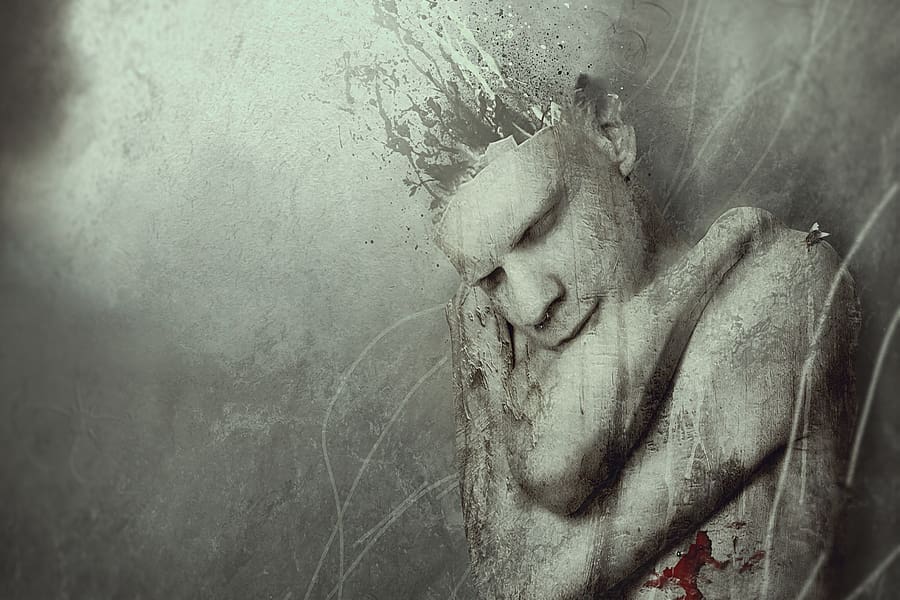
ASOV: I come from that old school of metal where you pray on bended knee to the almighty riff, so that usually comes first. But when I started The Unravelling, I had a plan to build off of one repetitive note and just follow it wherever it went. I knew the title and the general concept, and then I stumbled upon the cover (an incredible digital drawing by Pavel Kurbanov at All4Band Design) that just fit so perfectly. From there, writing the songs with that cover image in mind, I think the atmosphere just developed naturally as the songs took shape.
Q13: If The Unravelling accepts that all things exist to fall apart, what remains once the final hymn has finished? Where does A Sow of Violence travel after the dissolution presented by this EP?
ASOV: I haven’t decided yet if we’ll continue to fall apart. Maybe the next one will be more uplifting and I’ll call it The Putting Back Togethering.
Open Invitation — XIV: The final space is yours. Is there anything about A Sow of Violence, The Unravelling, Sleeping with Flies, your work as an author and musician, or what lies beyond this release that we have not explored and you would like our readers to know?
ASOV: If you’re new to A Sow of Violence and my work, thank you for joining the cult. If you’ve been following for a while, thank for tolerating my various manias. And to Kris and the wonderful folks at Athenaeum of Sin, thank you for letting me out of my cage long enough for the chat. Your support means the world.
Horns up!
This closes the interview. The rite is complete — the voice of Jason Korolenko now etched into the archive of sin.
I extend my deepest thanks to Jason Korolenko for sharing their voice — and to the reader, for bearing witness to this craft-rite.