Agarwaen — The Murder Trend Review
Agarwaen is a Finnish extreme metal (asylum metal) entity. On 3 July 2026, the band will release their debut full-length, The Murder Trend, released through Over The Border Records and promoted via The Metallist PR.
Agarwaen, The Murder Trend Review: Based upon a promotional copy provided ahead of release, this review will evaluate every aspect of the album, from its intricate musical composition to its production.
The First Three Sins, The Summary
The First Sin, The Strings/Keys: Crushing modern riffs, cinematic melodies, and unsettling atmospheres mirror Anton’s psychological descent with suffocating precision. The Second Sin, The Vocals: A theatrical, multi-layered vocal performance transforms every shift in tone into another manifestation of Anton’s fractured mind. The Third Sin, The Percussions: Powerful drumming and a commanding low end drive the narrative forward, evolving from crushing grooves into twisted, carnival-like rhythmic chaos.
The Fourth Sin, Overall Discussion
Opening The Ward
The Murder Trend is anything but your standard, everyday extreme metal release. When we featured Agarwaen‘s debut single, God Complex, the band described their chaotic sonic signature as AsylumMetal. Far from agimmick, the term accurately reflects an atmosphere that blends high-art horror with experimental theatricality.
The music functions as a sonic mirror, forcing the listener to peer through the eyeholes of Anton’s clown mask into the fractured machinery of an increasingly unstable mind.
The First Symptoms
The very instant the play button is pressed, the opening instrumental piece, False Arrival, greets the listener not with a standard riff or artificial studio introduction, but with an audio wave. As that wave breaks, the listener is thrust headfirst into the remaining ten hymns of the album and a horrific narrative descent.
The Birth of Anton
These hymns construct a deeply unsettling, serialised narrative tracking the tragic descent of Anton, a young man shaped by childhood abuse, social cruelty, and institutional neglect. His life changes catastrophically when he discovers an ancestral clown mask, a cursed relic that marks the irreversible beginning of his descent into madness.
Through Agarwaen‘s aggressive sonic arrangement, Anton’s psychological fracturing is laid bare. What begins as a story of trauma gradually evolves into a nightmare of ritualised murder, distorted carnival horror, cult manipulation, and an ancient curse, elevating the narrative far beyond a simple tale of violence.
Behind Padded Walls
Clocking in at just under sixty minutes, the record unfolds as a towering monument to pure madness and intense musical theatrics. Every single second of this runtime is captured through an elite display of creative devilmanship and a production design that can only be described as clinical, deeply claustrophobic, and psychologically invasive.
The instruments don’t just blast or groove; they are mixed with a sterile, cold precision that traps the listener inside Anton’s unravelling psyche, ensuring that the heavy sonic weight feels less like a concert stage and more like a padded cell.
What effectively separates The Murder Trend from contemporary releases is its refusal to aim for the glossy, heavily polished Finnish extreme metal sheen. Instead, Agarwaen deliberately cultivates a cold, sterile, fluorescent-lit atmosphere — the sonic equivalent of a mental hospital corridor at 3 AM.
The Fractured Mind
The production cultivates an intense, claustrophobic sensation, making it feel as if the microphones and instruments were placed directly inside Anton’s skull rather than in a professional studio environment.
This jarring proximity is entirely deliberate: the album’s overarching concept demands an uncompromised soundstage that mirrors raw childhood trauma, psychological dissociation, and a violent internal monologue. Agarwaen has delivered something that does not just tell a horror story; it physically locks you inside the main character’s unravelling mind.
Auditory Hallucinations
The vocal performance stands as the clearest indicator of The Murder Trend‘s mental-hospital aesthetic. It delivers a theatrical yet deeply grounded performance, functioning as a fluid, character-driven hybrid that mirrors Anton’s trauma, rage, and psychological unravelling through constant shifts in tone rather than relying on a single vocal mode.
The vocal performance becomes the primary vessel for Anton’s trauma — a descent that feels terrifyingly real.
- Manifestation I — The Overlapping Voices — the vocals shift seamlessly between cavernous, harsh deep growls and piercing, higher-pitched screams. These two extremes are frequently layered directly over one another, creating a sickening, claustrophobic intensity that highlights his internal chaos.
- Manifestation II — The Quiet Voices — the hymn integrates eerie spoken-word and half-whispered narrative passages. These moments strip away the extreme metal distortion entirely, presenting the raw, grounded voice of Anton’s trauma in its most vulnerable state.
- Manifestation III — The Fractured Voices — when Anton’s psyche completely fractures under social cruelty and neglect, the delivery pivots into nu-metal-adjacent rhythmic phrasing of a mind pushing past the point of no return.
- Manifestation IV — The Forgotted Voices — clean or semi-clean vocal lines are deployed with extreme scarcity. Used sparingly as a deliberate structural tool, these moments provide a fleeting, heartbreaking contrast that highlights the stolen innocence of the boy behind the mask before the primal brutality takes over.
The Anatomy of Decay
The guitar writing mirrors the plot with precision, altering its character to trace Anton’s mental decay:
- Phase I — The Violent Spirals — during Anton’s active descents into slaughter, the guitars lock into tight, percussive, down-tuned rhythm work that maximises the hymn’s claustrophobic weight.
- Phase II — The Traumatic Reflections — in the story’s quietest, most reflective moments, the distortion drops away to reveal cinematic, almost soundtrack-like clean passages — evoking the smoother, haunting intrusion of repressed memories.
- Phase III — The Carnival Horrors — during the surreal circus-themed sections, the fretwork contorts into nu-metal-inflected bends and strange, unpredictable syncopations that turn melodic lines into mocking, avant-garde nightmares.
The Machinery of Madness
Reinforcing the horror-metal and psychological weight of the album is the bass that sits prominently in the mix with a thick, body-forward presence, providing a dense visceral anchor beneath the chaos. The drumming is modern, punchy, and completely narratively reactive, utilising complex rhythmic patterns to actively drive the madness of the hymns forward.
Rather than delivering a static extreme metal blast, the percussion adapts structurally to mirror Anton’s evolving insanity across the record’s narrative chapters:
- Response I — The Early Chapters (Bad Beginning & God Complex) — the drums lock into a heavy, punishing groove-metal stomp, establishing the crushing weight of systemic neglect and social cruelty.
- Response I — The Theatrical Fracture (Clowny Business & Circo de la Muerte) — he percussion mutates into syncopated, circus-like rhythmic motifs, twisting familiar carnivalesque cadences into bizarre, avant-garde weapons of horror.
Layered beneath this sonic violence are low, menacing background textures that sit deep within the mix. Operating like distant institutional machinery, these ominous undercurrents utilise subterranean drones, metallic resonances, and cold atmospheric swells that mimic the fluorescent hum of a psychiatric ward or the static electricity trapped inside Anton’s mind.
Beyond the Cell
Overall, The Murder Trend is a theatrical-horror fruit of art — a definitive monologue of madness and psychopathology that sounds like a tight sonic straitjacket. The record refuses to offer a comfortable escape, trapping the listener inside the gritty psychological realism found in Joker while invoking the relentless dread of John Carpenter‘s Halloween.
This is far more than mere music; it serves as the rawest, most agonising expression of a character completely spiralling out of control into a suffocating vortex of violence and delusion.
The Final Descent
As the album officially closes with its over thirteen-minute title hymn, The Murder Trend, Anton’s dark interior monologue becomes fully externalised and weaponised. The journey ends in a cold, mechanical void that leaves the listener sitting in the dark, completely frozen by the grim psychopathology of what has just unfolded.
The Fifth Sin, The Memorabilia
When I first featured and experienced the band’s debut single, God Complex, I was immediately left wanting more — and this full-length debut has done significantly more than simply deliver. The album functions as a fruit of art and a carefully orchestrated descent into insanity. By the time you navigate your way to God Complex, the overarching madness reaches its boiling point, and by the time you reach the terrifying Circo de la Muerte, that madness has completely crept into your mind.
Experiencing this record feels like it was written as if it were a researched true-crime descent, borrowing acute psychological and social elements from real-world patterns of childhood abuse, systemic trauma, and cult grooming.
The Sixth Sin, The Artwork
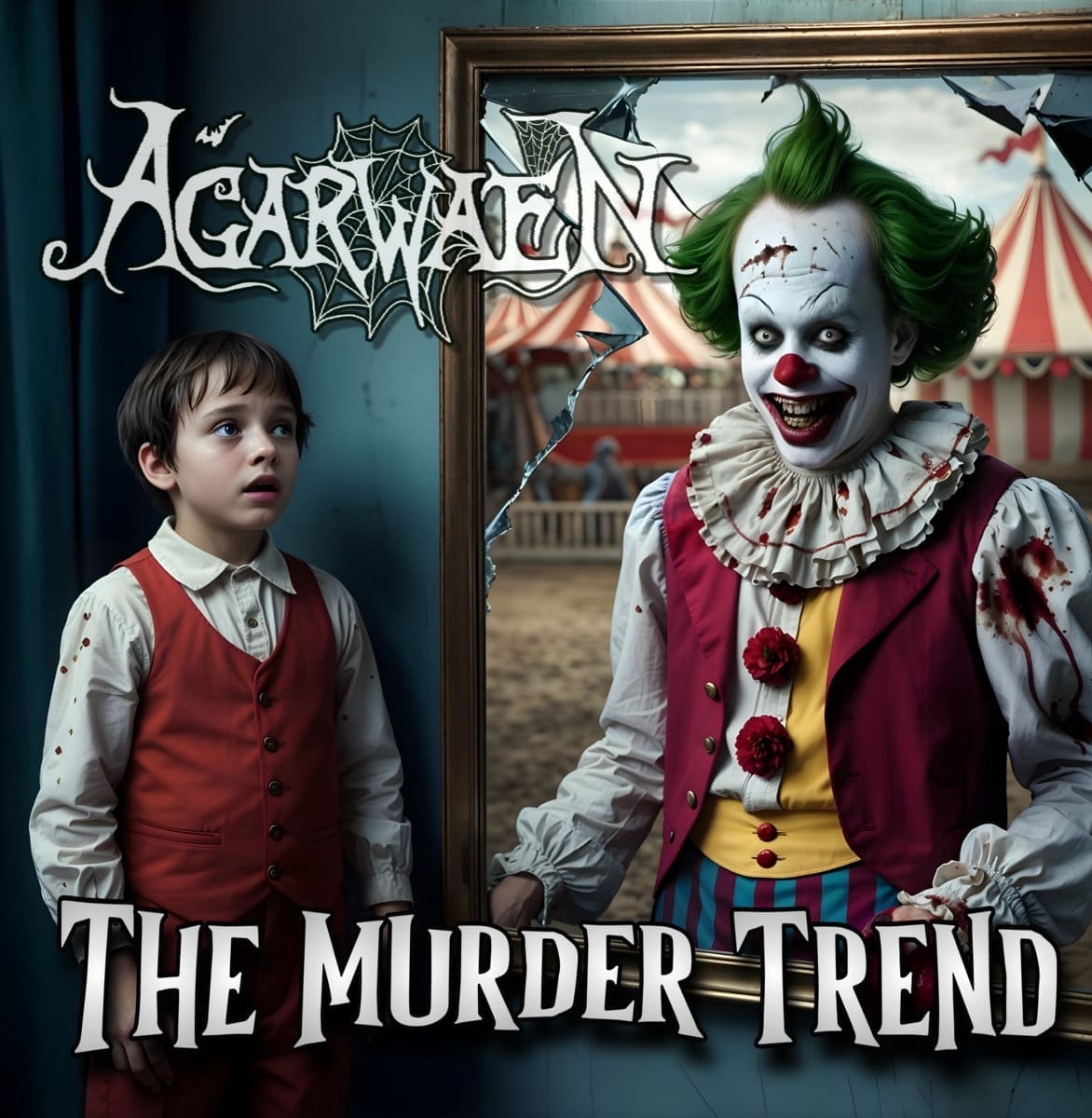
The artwork acts as a direct, honest doorway that immediately tells the core story of Anton and his descent.
The Seventh Sin, Disrelish
I find little to disrelish on this powerful release. The only inherent risk is that its intense, experimental theatricality and claustrophobic asylum atmospheres make it an intensely acquired taste.
It is an album that demands total psychological immersion, meaning it will not be everyone’s cup of tea — but for those who crave authentic, psychologically invasive horror-metal, that exclusive, unsettling nature is precisely what makes it such a compelling theatrical horror fruit of art.
The Hymns
01. False Arrival
02. Bad Beginning
03. God Complex
04. Orphan Son
05. La colección
06. Circo de la muerte
07. The Hunt
08. Clowny Business
09. Aenimus
10. The Murder Trend
Agarwaen
Anthony “Vryko” Hodju — Guitars, Vocals
Dr Wolfram – Bass
Pete Bay – Guitars
Szilard de la Costa – Drums
Crazy Gustav – Rhythm Guitars
Vermin – Actor
Hear The Music
Social Links
Over The Border Records | Home Page
Over The Border Records | Facebook