Vampire Valentine — Scarred and Sacred Review
Vampire Valentine is a UK post-punk/darkwave entity. On 25 October 2026, Vampire Valentine released their third EP Scarred and Sacred through Morella Records.
Vampire Valentine, Scarred and Sacred Review: This review will evaluate every aspect of the album, from its intricate musical composition to its production.
The First Three Sins, The Summary
The First Sin, The Strings/Keys: Haunting synthesisers, spectral guitars and brooding bass weave a cinematic tapestry of darkness. The Second Sin, The Vocals: Hypnotic chants, mournful baritones and ritualistic whispers echo through the gloom. The Third Sin, The Percussions: Pulsating rhythms shift between mechanical aggression and restrained, atmospheric dread.
The Fourth Sin, Overall Discussion
A Descent into Darkness
From the very first press of the play button, Vampire Valentine invites the listener into a chillingly immersive sub-twenty-minute sonic journey. Scarred and Sacred wastes no time establishing its aesthetic, immediately enveloping the audience in a rich, meticulously crafted soundscape of classic gothic post-punk and shimmering darkwave.
Six Hymns, One Dark Ritual Dance
Spread across six sequenced hymns, the EP is far more than a collection of dark club hymns; it functions as a singular, cohesive ritual. Together, these six hymns weave a dark, interconnected narrative that explores the heavy themes of human sin, agonising repentance, and the ultimate, inevitable reckoning of facing final judgment at the desolate gates of the afterlife.
The Veil of Shadows
Musically and conceptually, what makes Scarred and Sacred particularly compelling is that it refuses to operate merely as a collection of standalone hymns. Instead, the release behaves more like an immersive, six-part dark cinematic narrative — a psychological descent that moves deliberately from unease, guilt, and mortality toward a harrowing reckoning with judgment and the faint, flickering possibility of redemption.
This journey begins with the instrumental opening piece, Scarred, which immediately envelops the listener in a dense fog of atmospheric textures and lush, orchestral-style layering. Traditional rock instrumentation is entirely subverted here: any guitar presence is deployed strictly as drifting ambience rather than serving traditional riff construction, while the bass remains largely subliminal, haunting the composition from the shadows like an unseen spectre.
Against this fragile, ghostly backdrop, the percussion emerges as the primary physical force, a rhythmic pulse that steadily tightens the tension beneath the delicate, floating melodic elements.
Ultimately, the soundscape of Scarred and Sacred transcends the boundaries of traditional darkwave. Driven by haunting string arrangements, sweeping ambient synthesisers, and spectral orchestral textures, the hymn feels far closer to a dark film score or a psychological thriller soundtrack than conventional genre fare, pulling the listener deep into its shadowed, cinematic world.
The Cathedral of Broken Souls
The subsequent hymn, Broken Sins, instantly establishes itself as an oppressive and inescapable sonic prison. Within this desolate landscape, the synths refuse to linger merely as a passive background texture; instead, a spectral, organ-like timbre aggressively takes the foreground, actively forging the hymn’s bleak emotional identity.
This piercing element conjures a suffocating atmosphere of religious dread, suffused with a heavy, palpable sense of spiritual corruption.
Beneath this sacred-turned-profane aura, the rhythm throbs with the agonising cadence of a heartbeat spiralling into acute distress. Intertwining with this relentless pulse, the strings weave a complex and unsettling tapestry: they alternate fluidly between mournful, weeping melodic phrases, jarring and abrasive rhythmic attacks, and deep, shuddering bass riffs that rigidly anchor the shifting chords.
Piercing through this suffocating instrumentation, the vocal delivery adopts a hypnotic, chant-like quality — repetitive and fiercely ritualistic, echoing the chilling devotion of a lost congregation.
An Amulet for the Departed
As the EP reaches its third hymn, Talisman, the landscape shifts decisively into the supernatural. Here, the instrumentation becomes far more aggressive and unrelenting: the guitars slash through the mix with sharp, confrontational passages, backed by hard-hitting percussion that injects a visceral, high-octane energy into the composition.
Amidst this sonic assault, the synths take on a chilling, atmospheric quality, echoing the classic melodic architecture of traditional darkwave. Above the gloom, the vocals merge with a palpable sense of desperation and menace, perfectly matching the hymn’s eerie undercurrents.
Lyrically, the song weaves a haunting narrative about a physical amulet serving as a companion for a deceased loved one crossing over into the great unknown — a poignant sentiment captured in the central plea: “Take it with you when you see the other side.”
Yet, rather than descending into apocalyptic wrath or cold condemnation, his vocal delivery is heavy with genuine grief, transforming what could have been a menacing incantation into a heartbreaking farewell.

The Mechanical Heart of Darkness
Moving deeper into the sonic architecture of the release, the fourth hymn, LNAB (Lover Not A Biter), elevates the synths to the absolute centrepiece. The composition is relentlessly propelled forward by aggressive, razor-sharp arpeggiators, piercing cinematic synth leads, horror-infused electronics and grit-laden retro-futurist textures that evoke a sense of analogue decay meeting digital precision.
Beneath this synthetic onslaught, the percussion rhythm transforms into something cold, machine-like, and strictly cybernetic, yet undeniably dance-driven — forcing a kinetic pulse into the darkness. Amidst this electronic machinery, the strings do not demand dominance; instead, they operate in haunting synergy with the programming, weaving tension through the margins rather than dictating the melody.
A Blood-Soaked Symphony
Following this nocturnal acceleration comes the fifth hymn, GORE!, where the traditional rock elements — guitars and bass — are deliberately relegated to a secondary tier, serving the overarching electronic framework rather than leading it. Here, the composition prioritises atmosphere over conventional songwriting; it’s a devilish art in texture, creeping tension, and sudden volatile bursts of aggression rather than melodic comfort.
The relentless drums feel less like a standard percussive beat and more like a mechanised pulse, engineered explicitly for cinematic impact and visceral weight.
Across both movements, the dominant voice remains undeniably synthetic. This is a blood-soaked crossroads where the chilling minimalism of John Carpenter collides with the occult prog-horror of Claudio Simonetti’s Goblin, filtered through the neon-drenched dread of synthwave and the heavy, distorted aggression of modern dark synth.
Together, the compositions evoke a visceral, cinematic narrative arc: the paralysing feeling of dread, the adrenaline of pursuit, the suffocating panic of being cornered, and ultimately, a violent, cathartic climax.
The Art of Dark Devilmanship
From a musical standpoint, the band’s diabolical devilmanship is executed with breathtaking precision. Their devilish instrumentation and labyrinthine composition transcend mere gimmickry, resulting in a demonstration of dark devilmanship. Not a single hymn relies on recycled formulas; instead, every hymn possesses its own distinct identity, ensuring the EP remains fiercely unpredictable and utterly devoid of dull or repetitive moments.
The Final Reckoning
The EP reaches its chilling, cinematic horror-score aesthetics with the closing hymn, Sacred. Here, the composition naturally drifts into a vast, desolate modern post-punk atmosphere. The guitar abandons traditional aggression in favour of sweeping spatial resonance, bleeding melancholy textures and icy air into the mix.
The bass guitar once again anchors the piece as its indomitable foundation, while the drums trade rhythmic conflict for a restrained, meditative support that invites deep reflection. At the cold, beating heart of the composition lie the vocals and synthesisers.
The synths deliberately eschew the role of lead instrumentation, instead wrapping the hymn in a haunted, spectral ambience that feels pulled from the fog of a forgotten nightmare. Above this sonic fog, the vocals deliver a haunting performance, culminating in a pivotal, spine-chilling spoken-word passage near the conclusion:
“Could you forgive a man who spent his whole life stealing, cheating . . .”
A Cinematic Fruit of Darkness
Ultimately, Scarred and Sacred transcends mere songcraft to become a work of dark, atmospheric storytelling. It is a stunning fruit of art that seamlessly bridges modern darksynth, darkwave, post-punk, and old-school Gothic rock, all through the lens of classic, giallo-esque Italian horror soundtrack composition.
The Fifth Sin, The Memorabilia
As a devout lover of extreme metal, my musical palate is usually dominated by blast beats, guttural roars, and crushing wall-of-sound distortion. Yet, every metalhead has their secret archives, and a few of my most cherished guilty pleasures lie within the brooding shadows of dark wave, post-punk, and old-school gothic rock.
Enter Vampire Valentine.
This EP doesn’t just capture the essence of those nocturnal genres — it masterfully resurrects them. From the very first spin, the sonic lineage is vividly alive. I could hear the ghost of Ian Curtis’ baritone alongside the driving bass lines straight out of Joy Division. There is the melancholic shimmer of early The Cure, the cavernous drum machines and baritone sneers of The Sisters of Mercy, and the theatrical, angular gloom of Bauhaus.
There are spectral echoes of Fields of the Nephilim, the electronic pulse of Blutengel, and the cinematic, atmospheric dread of Nox Arcana, alongside a few other subtle nods to the architects of the dark alternative underground.
However, hymns four and five capture not only darkwave but the aggressive dance beats characteristic of aggrotech — yet another of my guilty-pleasure rabbit holes.
On top of the sound, there is a wonderful sense of local pride woven into the experience. Vampire Valentine hails from Newcastle-upon-Tyne, while my own stomping grounds lie just down the road in County Durham.
There is something deeply satisfying about knowing such artistry is brewing right in your own backyard.
The Sixth Sin, The Artwork
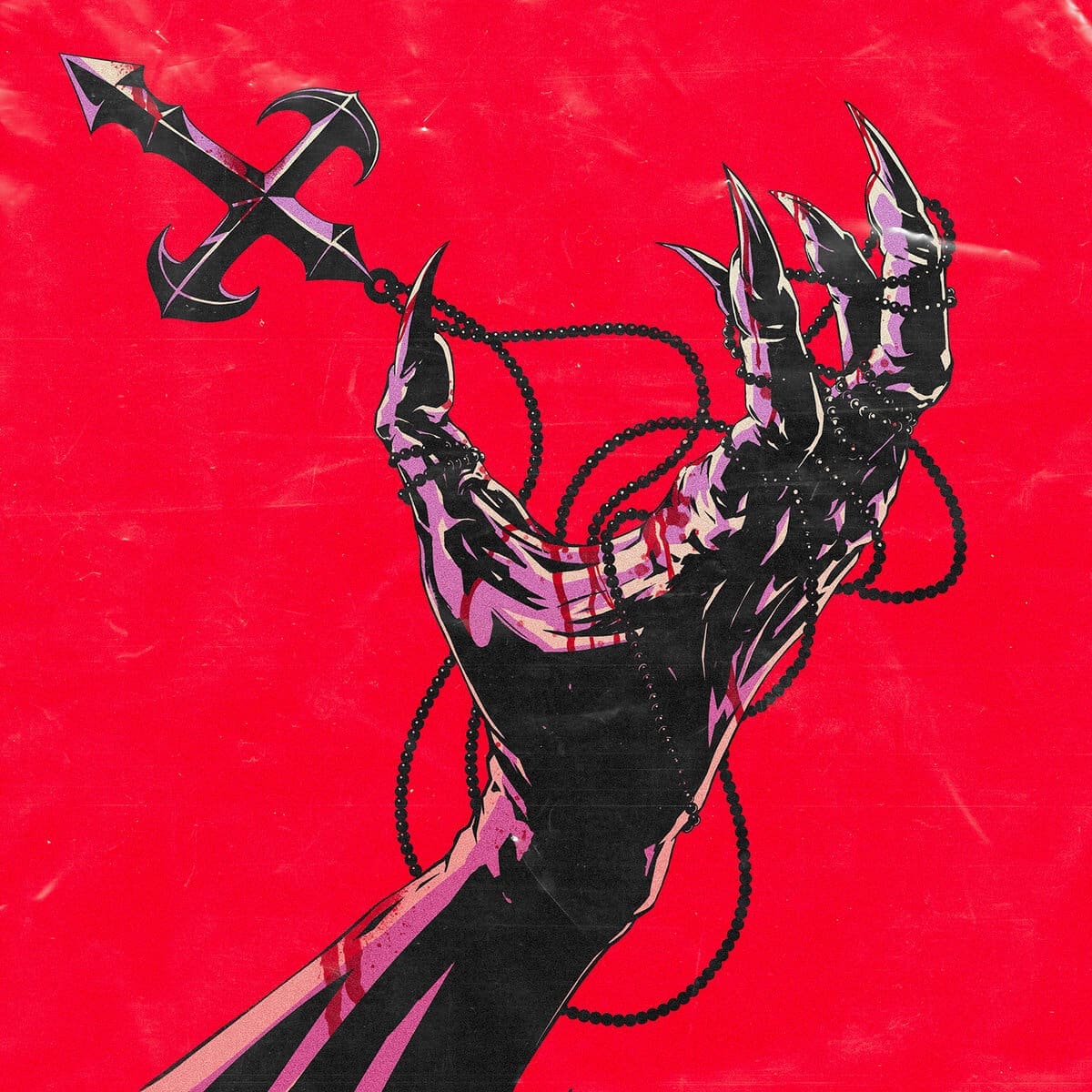
To top it all off, the physical and visual presentation is flawless; the artwork mirrors the gothic romance and cinematic dread woven into the music’s narrative.
The Seventh Sin, Disrelish
Ultimately, there is simply nothing to dislike here. My only real complaint? The repeat button on my player is completely dead — worn out from dancing itself to death.
The Hymns
01. Scarred
02. Broken Sins
03. Talisman
04. Lover Not A Biter
05. GORE!
06. Sacred
Vampire Valentine
Michael Longstaff — Vocals
Kieron Wright – Bass
Tobias Cowen Pickard – Drums
Ricky Conover (Forerunnerx) – Composer (Scarred, Lover Not A Biter, GORE!)
Blake Carpenter – Guitar (Broken Sins, Talisman, Lover Not A Biter, GORE!)