Eusapia Interview
The Interview — Eusapia: Nondualism, Pacific Northwest Isolation, Mortality, & Sonic Transformation
Eusapia emerges from Washington State’s underground landscape through a deeply atmospheric and emotionally driven approach to extreme music. Since returning from a decade-long hiatus, the collective has developed a distinctive sonic identity where personal experience, philosophical contemplation, natural surroundings, and atmosphere become integral parts of the musical journey.
This interview explores the creative world behind Eusapia. Across thirteen questions, we journey through the entity’s resurrection, creative philosophy, Pacific Northwest surroundings, the personal weight behind Relapse and Mercy, and the path that lies ahead.
Thirteen Questions constructed through nondualism, Pacific Northwest isolation, mortality, & sonic transformation.
Q1: For those encountering Eusapia for the first time, who are you, where are you from, and who currently forms the collective?
Cleopatra the Alchemist: First of all, thank you, I’m Cleopatra the Alchemist and I perform vocals and guitar. Eusapia is a progressive blackgaze band otherwise composed of Somnium (bass), Deenie (drums), Chazdyn (guitars) and Frank Keeler (guitar). We all live in western Washington state, most of us are in Aberdeen.
Q2: Eusapia was originally formed in 2013 before entering a decade-long hiatus and ultimately returning in 2024. What brought the entity back to life, and how different is the Eusapia of today from its original incarnation?
Cleopatra the Alchemist: Eusapia‘s first life was really short lived and the breakup was extremely sudden and honestly, I didn’t really ever want or expect a resurrection of the name, and had moved on to other projects and eventually kinda decided I was done making music to be honest.
So there wasn’t really a plan to make Eusapia 2.0 or whatever. I think the point that it really became apparent though was reuniting Deenie and I, he was in the original lineup and ever since then I’ve always considered him my drummer, like every idea I have had since I’ve wanted his drums for. Somnium was never really meant to be a band, I never really even “joined” it, I was mainly providing lyrics and a few screams but the chemistry was really good and we started thinking in terms of “us.” When we started talking about a lineup, Deenie was the first person to come up, I have loved working with him in the past and basically told him I would do anything to get him behind a kit for us, when he agreed we kinda sat back and realized we were making music that was already so closely related to our first iteration as Eusapia that we should reclaim the name and be eusapia again, it just made sense.
I really don’t think Eusapia today is any different than it was, the music and creative engine are very much inspired from the same place. Our lineup is different, but Somnium and I have such a similar creative vision that it feels like Somnium was sort of the cocoon that we needed to spread our wings and nurture this thing back to life.
Q3: Somnium’s early instrumental mixes of hymns such as Formless and Blue Idol played an important role in drawing Cleopatra back into Eusapia. What was it within those recordings that reignited the creative spark?
Cleopatra the Alchemist: The short answer is that he was writing the music I wanted to be making. We’ve known each other for years, and he was in the last band I played in. That project was very creatively stifling for me and a huge part of why I decided I was done.
So when Somnium reached out initially I outright said that I didn’t want to play music, but he sent the songs anyway and it was rapturous. I’ve said that I wanted to make music that felt heavy in your heart but not necessarily in your ears and Formless was that, there were no drums, it’s almost all acoustic, and frankly its pretty, but there is this intense emotional weight that it carried that really shook me.
Q4: Eusapia employs a formidable three-guitar wall of sound, moving between tremolo-driven aggression, doom-laden weight, shoegazing textures and dreamlike ambience. How do three guitarists construct such a dense sound without sacrificing clarity or individual identity?
Cleopatra the Alchemist: I think the biggest thing for us is that its not about the individual identity, we really respect the “song” and where they come from. Two guitars are tuned to standard d while one is tuned in CGCGCD. Our CGCGCD guitar is treated sort of like a second bass, or a bed layer. The “main” guitar part is generally played with more full chord voicings and our lead generally sits in a higher frequency range, using either soaring leads or complimenting harmonies.
I guess we treat our string section like a violin, viola and cello as a baseline or foundation. I think one of the factors that makes it all work is that we allow our bass to carry a lot of the distortion, and that gives us some room for clarity between the three guitars without sacrificing the “heaviness” in those moments that feel like they need to be crushing.
Q5: Deenie’s movement-oriented approach to percussion has been described as a core songwriting engine within Eusapia. How much does the percussion shape the direction of a composition rather than simply accompany material already written?
Cleopatra the Alchemist: We just don’t think of songs as even done until he comes to the room, it’s like a guitar part or vocals, his playing feels lyrical and expressive so until he touches the tracks, they feel rough and lifeless. Once we capture a performance from him, that gives us the character of the entire song.
Going back over and retracking to his drums informs how we approach a blast segment or maybe the way we pick during a movement, like all downstrokes with some rock feel or a more shoegazey strum. They seem like little things, but at the end of the day it shapes so much of our sound.
Q6: Nondualism, mystical poetics, impermanence and mortality appear deeply embedded within Eusapia’s identity. How do these philosophical ideas find their way into the music and lyrics without becoming detached from the human experiences behind them?
Cleopatra the Alchemist: This is such a great question, thank you. Our lyrics are poems first, I simply don’t think of them as lyrics at all and the process of fitting them into the song is completely different than writing them. I think a lot of nondualism at its core is this exploration of identity, mysticism is the vehicle that I personally use to do this.
Things like mortality and impermanence, I think, fuel a lot of people’s drive to find answers in spirituality and surely are where I think my journey also began. For me, the mystical poetry is just a byproduct and comes from a very human, very emotional place. As a writer, I’m just exploring my own experience, questions, spiritual work or maybe I’m just processing a time or event. I’m a deeply spiritual person who is sort of always “on” when it comes to that, so it is just sort of a part of who I am, and I think that honesty is what keeps the songs grounded.
Q7: The isolation, rain-soaked landscapes and concrete surroundings of coastal Washington and the wider Pacific Northwest seem almost inseparable from Eusapia’s atmosphere. How strongly does your environment influence the way the collective writes and visualises its music?
Cleopatra the Alchemist: The PNW has a spirit that really becomes part of your DNA, the trees are these monolithic walls that surround you constantly. They eat the sky, when we have one, but normally it’s this endless grey that’s often open with rain. The shimmer of glassy rain on silver streets reflecting the drab sky, is gorgeous in its own right and I think those things are the same things that all the local acts have in common.
Personally, I am in nature a lot and spend a lot of time foraging and hiking, looking for mushrooms, for instance, isn’t a very dry activity. Really, nothing is, which why I think this area celebrates a really rich history of being musical, playing music is all-ages and rain proof.
Historically, bands like Nirvana and The Melvins, have really showcased a lot of that same spirit and if you were to explore some of the other local acts playing now or over the last 30 years, you’d see that even spanning genres, there is something about this area that we undoubtedly find inspiring, but I hear in all the music around us as well.
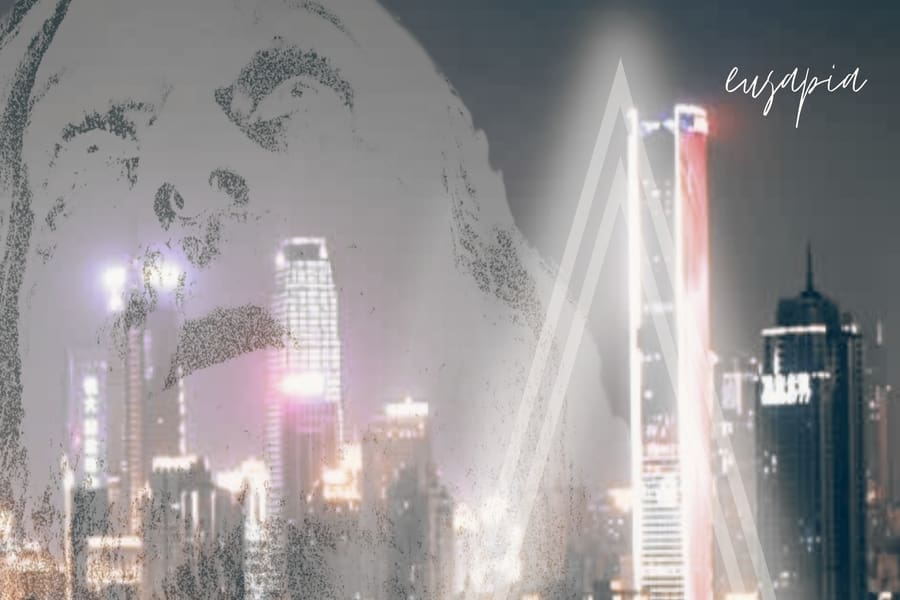
Q8: Thin Cities/Desert Festival demonstrated a striking collision of post-black metal, shoegazing atmosphere and a noticeable depressive black metal undercurrent. Looking back at that EP, what did those hymns establish about the sound Eusapia wanted to pursue?
Cleopatra the Alchemist: Those songs were the origins of Eusapia and I think the sort of holotype we work from, the drama and presentation that those songs bring are really what we want out of our music. While we’re incredibly excited to be releasing Mercy, I think The Grove will be a return to form, and you’ll see a lot of that framework from the Thin Cities / Desert Festival EP.
Q9: Relapse turns towards the cycles of addiction and suicidal depression within an autobiographical framework. How did you approach translating subjects of that weight into music without diminishing their seriousness?
Cleopatra the Alchemist: These are my lived experiences, I’m an alcoholic, I have bipolar disorder and have been suicidal for a lot of my life. Being around other addicts and alcoholics as a foundation puts you in a position where you are forced to acknowledge the realities of mortality, suicide, depression, its just my life.
I don’t want to glamorize it, or make it sound like some inspirational bullshit, I just want to be honest about these things. I’m lucky to be sober today but being old and sober often means you’ve been confronted with a lot of death and you sort of respect that gravity.
Q10: Relapse begins a two-stage cascading release that will conclude with Mercy on 21st December and form the complete two-hymn Mercy EP. Why did you choose this waterfall-style release rather than presenting both compositions simultaneously?
Cleopatra the Alchemist: Those two were almost spontaneous additions, with Mercy being included as an afterthought because it was so close thematically to Relapse.
Relapse was originally going to be a single, so honestly, we’re still finishing up Mercy and we wanted to give ourselves time to establish a relationship with a local nonprofit that works with harm reduction in communities that suffer from addiction. Our coming EP The Grove and our first full length Blinding Light didn’t seem like the right place to put either of those songs, but they felt right together so that decision was really spontaneous and I feel like they are a more DSBM focused pairing than what listeners might typically expect from us as a whole.
Q11: Recording was undertaken with Aaron Cain at Fern and Feather Studios, while Chris Toy at Somnium Recordings is handling mixing and mastering. With Eusapia balancing three guitars, atmospheric layers and considerable dynamic weight, what are the priorities when shaping the production of Mercy?
Cleopatra the Alchemist: Priority is always to serve the song, we feel like these songs are sort of channeled through us rather than being written, so the focus is always on the entire body of work and not just one part. But, specifically this release, I think we wanted to create a sense of intimacy. These songs are about death. One is a reflection on navigating my own suicidal ideations and the other is about the death of a friend, both are challenging topics and deeply personal so I think that we wanted to make them feel personal and close.
Q12: A portion of physical merchandise proceeds from the Relapse and Mercy cycle will support grassroots harm-reduction work. Why was it important for Eusapia to connect the themes explored within Mercy to direct mutual aid outside the music itself?
Cleopatra the Alchemist: We are humans in a community that suffers greatly from addiction, most of us have friends or family who have died from addiction and these two songs are about addiction and mortality, these songs are inspired by real life, real people and real people still suffer. I am so far away from my last drink that my suffering takes a different shape, but a part of what helps keep me sober today is being in touch with that part of my life.
I’m lucky, but if there is a way that we can help our community reduce some of the harm that drug addiction and the suffering that it brings down a little bit, then we’re going to do it. Thin Cities and Desert Festival also have merch that we’ve pledged to different nonprofits as well, it may be small but if we’re playing a song about something that people are suffering from today, we want to try to improve the material circumstances for those people, otherwise why would we even be talking about it?
Q13: Once Mercy completes its cycle in December, where does Eusapia travel next? Has the experience of creating this deeply autobiographical material changed what you want the collective to explore musically, lyrically or philosophically?
Cleopatra the Alchemist: Next we’re working on an EP called The Grove, which, is essentially one long song that explores identity through this mystical forest garden and its relationship to the observer and the keeper of this space. I don’t think the Mercy EP really defines or shapes us in anyway, but rather, is something that lives in its own space.
We’re more focused on creativity than fitting into a sort of box, so we look at our albums and EPs like we do our individual songs, from the whole body instead of individual works, but that allows us to sort of say what we need to and move on. Once The Grove is done, we probably won’t be revisiting that garden either, we’ll move on to Blinding Light and say what we need to then.
Open Invitation — XIV: The final space is yours. Is there anything about Eusapia, Relapse, Mercy, your philosophy, the people behind the collective, or what lies ahead that we have not covered and you would like our readers to know?
Cleopatra the Alchemist: We just want to thank you so much for taking the time to introduce us to your readers, it means a lot to us. I guess one, coincidence that I can’t help but appreciate is that I look at the Formless EP as if they are sort of nondual hymns, so your format was surprisingly fitting.
This closes the interview. The rite is complete — the voice of Cleopatra the Alchemist now etched into the archive of sin.
I extend my deepest thanks to Cleopatra the Alchemist for sharing their voice — and to the reader, for bearing witness to this craft-rite.