Signs Of the Evil — Calling the Ancient Legions… Review
Signs Of The Evil is an Peruvian primitive black metal entity. On 2 March 2026, Signs Of The Evil released their third independent full-length, Calling The Ancient Legions Under The Red Moon.
Signs Of The Evil, Calling The Ancient Legions Under The Red Moon Review: This review will evaluate every aspect of the album, from its intricate musical composition to its production.
The First Three Sins, The Summary
The First Sin, The Strings/Keys: Primitive war-driven riffcraft, hypnotic tremolo repetition, militant black-metal aggression, and spectral ghost-key atmospherics forge a hostile ritual landscape steeped in ancient darkness. The Second Sin, The Vocals: Venom-spat incantations, commanding ritual proclamations, and blunt adversarial phrasing transform each lyric into a curse hurled directly from the abyss. The Third Sin, The Percussions: Relentless blast beats, punk-infused d-beat momentum, and crushing war-march rhythms create a primitive rhythmic engine that drives the album’s hostile ceremonial assault.
The Fourth Sin, Overall Discussion
The Crimson Invocation
Upon pressing the play button, the opening hymn, Invocato Infernal Reges, greets the listener not with immediate fury, but with the ominous tolling of bells and the chilling atmosphere of a ritual summoning.
It is a cinematic and sinister threshold, designed to strip away the modern world and prepare the soul for the ancient, nocturnal forces that the band is about to unleash.
By starting with a literal invocation, Signs Of the Evil makes it clear that this release is not merely a collection of hymns, but a structured dark ritual conducted under the bleeding eye of a red moon.
Beneath the Blood-Red Moon
As the listener crosses the threshold of the invocation, the journey plunges into the remaining hymns, eventually exhaling its final breath with the closing Outro. Across its forty-five-minute runtime, Calling the Ancient Legions Under the Red Moon balances the raw, chaotic energy of black metal with a calculated assault — each hymn acts as a distinct chapter in a grand Grimoire of rebellion, sustained by a freezing atmosphere that never lets up, until the final outro falls silent.
This is not an album that leaves room for compromise, but an uncompromising invocation of chaos, blasphemy, and eternal darkness built upon the thematic foundations of black magic, hate, war, and adversarial pride.
Signs Of the Evil delivers their message not with theatrical warmth, but with a freezing, razor-sharp malice that forces the listener to face the abyss head-on.
Signs Of The Evil Speaks — The Grimoire Unsealed
Signs Of The Evil states: “Calling the Ancient Legions Under the Red Moon” draws from Sumerian, Akkadian, and Babylonian cosmology, where divinity and demonology were not moral concepts, but expressions of raw cosmic function. Ritual, invocation, sacrifice, and blasphemy are treated not as narrative elements, but as acts of alignment with these ancient currents.
Lyrically, the album moves between English, Spanish, Sumerian, and Latin, forming a fractured ceremonial language that reflects the instability and violence of these forces.
Each composition functions as a symbolic operation rather than a song – an opening, a tension, a collapse. Guided by the imagery of the blood-red full moon, the album exists as a cycle: attraction, union, destruction, and silence. Pure manifestation of Evil.
The Forked Tongue Falls Silent — Primitive Strings of War & Darkness
Each hymn is distinct in its own way. The fourth hymn, Glory & Pride, serves as a brief instrumental interlude, while the following hymn, Rutuale Fragellationi, embraces a slower blackened-doom movement — death-wish-driven and oppressive — before its tempo rises into a more primitive and memorable assault.
This unholy devilmanship is executed with primitive perfection, crafting a raw, rural atmosphere born of stripped-back instrumentation and ancient musical craft. Built firmly on the historic South American black metal lineage, the guitars are intentionally primitive, militant, and war-driven.
Tremolo riffs are hammered out in long, unbroken phrases, utilising minor-key, war-march patterns that deliver a tone that is bone-dry, mid-forward, and sandblasted— completely untouched by modern studio polish. In one breath, the strings are feral, scorched, and relentlessly hostile. The songwriting rejects the standard rules of melodic development in favour of a hypnotic, ritual repetition.
The guitar lines assault the listener over and over, creating an oppressive wall of sound that feels less like a performance and more like an ancient, auditory curse.
Beneath the guitars lies the bass — a blunt, subterranean presence — it completely bypasses melody to serve pure, crushing weight, anchoring the hymn with a low-end density.

The March of Iron Legions
The percussion shifts seamlessly between relentless straight blasts, punk-infused d-beats, and heavy, war-stomp rhythms. The toms carry a dry, hollow resonance that evokes the gritty, claustrophobic acoustics of a rehearsal room rather than a sterile studio.
When keyboards or synths do appear, they function strictly as ghost-keys. They exist as a faint, spectral presence lurking far behind the sonic violence — an eerie, atmospheric dust rather than a featured instrument, ensuring the primitive fury of the release is never diluted.
Venom Through the Ritual Tongue
The vocal delivery is an engine of pure black metal aggression, perfectly aligned with the band’s hostile themes. There are no clean vocals to be found here, nor any atmospheric choirs to soften the blow; instead, the delivery relies on short, violent, and incantatory phrasing.
The tone feels entirely spat rather than sung — a venomous, rhythmic ejection of words that slices through the primitive instrumentation. It carries a commanding, ritualistic weight, turning each lyric into a direct curse.
By keeping the phrasing blunt and aggressive, Signs Of the Evil ensures that the vocal performance mirrors the militant pace of the guitars, driving the chaotic momentum of the music.
The Sound of the Underground Abyss
The production is an exercise in pure Peruvian rawness. It deliberately shuns the modern comforts of standard mixing, pushing the dry, abrasive guitars far forward into the listener’s face while reducing the bass to a murky, subterranean throb. The drums are rendered in thin, metallic cracks and a hollow room-tone that evokes the raw energy of a live ritual.
Sitting above this sonic chaos are the vocals — recorded hot and hostile, they slice through the mix like direct proclamations rather than rehearsed studio performances. Interestingly, any atmospheric residue — such as those faint, organ-like overtones — feels almost accidental. It is a texture born from the natural friction of guitar feedback and raw room reverb, rather than deliberate synth layers.
The entire recording proudly rejects clinical clarity in favour of sonic immediacy, capturing Signs Of the Evil in their truest form: feral, unpolished, and intensely ritual-charged.
When the Legions Withdraw
The album’s final gesture is a brief but potent ritual fragment: Outro. This one-minute descent seals the record in a suffocating haze of nocturnal dread. Here, the violence ceases — there are no primitive riffs, no venomous vocals, and no martial war-drums.
Instead, the listener is left with only a cold, atmospheric residue. It is the sonic equivalent of black smoke rising slowly from a blood-soaked battlefield after the legions have finally withdrawn back into the shadows.
The Ancient Summoning Complete
Overall, Calling the Ancient Legions Under the Red Moon is a dark, raw, and uncompromising fruit of art. It stands as a feral monument to the primitive South American underground, offering no quarter and demanding total submission to its hostile, black-magic ritual.
The Fifth Sin, The Memorabilia
For me, Calling the Ancient Legions Under the Red Moon embodies many of the qualities that first drew me towards black metal: atmosphere, ritual, occult mysticism, primal darkness, and an unwavering commitment to the underground spirit.
It is music that feels unapologetically primitive — an audio-borne nightmare that is freezing cold to the touch. What makes this offering even more unique and vital is its distinct Latin American black metal identity. It carries that unmistakable, unpolished underground spirit that simply cannot be replicated by Western studios, serving as a fierce reminder of how raw and uncompromising true black metal was always meant to be.
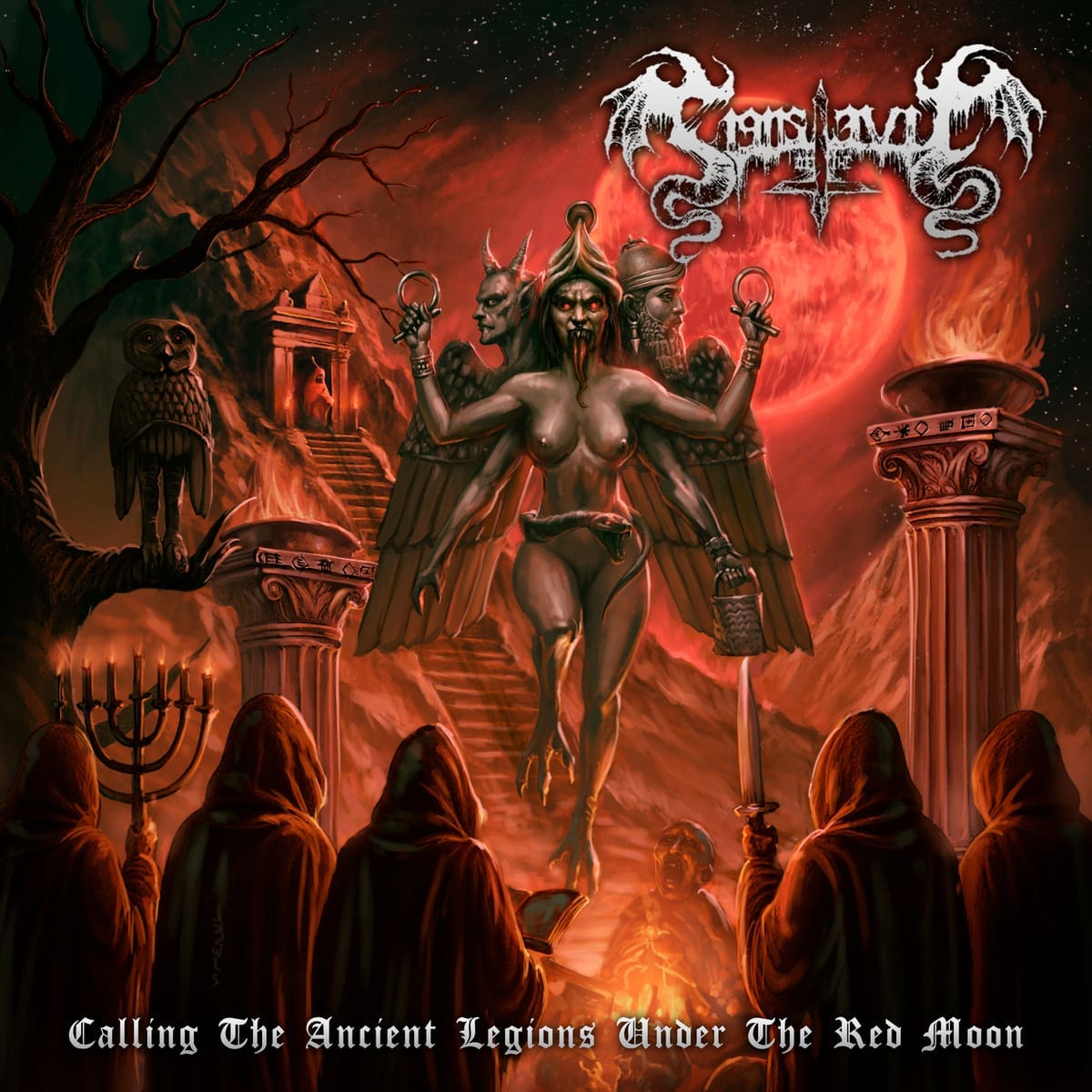
The visual canvas serves as a flawless, syncretic occult tableau — ancient in posture, yet unbound by any single lineage. The artwork masterfully blends deep Mesopotamian demonology with striking, pop-mythic silhouettes. It features a tri-headed, Pazuzu-like guardian rising formidably over red-robed supplicants, accompanied by a cosmic serpent that seems to thread the line between the Garden of Eden and the ancient deity Ningishzida.
Nearby, Lilith is seamlessly fused with a harpy-edimmu form, while a solitary owl sits as an entity caught between Athena’s omen and a Mesopotamian watcher-spirit. It is a stunning, multi-layered visual Grimoire that mirrors the savage ritualistic complexity of the music inside.
Art that corresponds with the music — music that corresponds with the art.
The Seventh Sin, Disrelish
I find very little to disrelish on this release. Signs Of the Evil has delivered a completely untamed, sandblasted, and authentic piece of South American black metal art. Its hostility is addictive, and its refusal to bow to modern production trends makes it a powerful monument to the eternal underground.
The Hymns
01. Invocato Infernal Reges
02. Black Metal War
03. Legion Samael
04. Glory & Pride
05. Rituale Fragellationi
06. Cristus Desecrato
07. Black Goddess of Destruction
08. Cursed Mountain
09. Tiamat’s End
10. El llamado de Marduk
11. Negra noche
12. Outro
Signs Of The Evil
Hellthor — Guitars
Belcifer – Vocals
An Hell – Drums