Saint Omen — Mysteries of Rebirth Review
Saint Omen is an occult narrative doom metal solo project from the United States. On 5 November 2025, Saint Omen released his second independent full-length, Mysteries of Rebirth.
Saint Omen, Mysteries of Rebirth Review: This review will evaluate every aspect of the album, from its intricate musical composition to its production.
The First Three Sins, The Summary
The First Sin, The Strings/Keys: Thick, 1970s-horror fuzz dominates, with slow, hypnotic riff cycles and subtle synth veils shaping a psychedelic, smoke-drenched atmosphere. The Second Sin, The Vocals: A spectral, Ozzy-tinged rasp delivered as ritual incantation—half-spoken, half-sung, guiding the listener through the occult haze. The Third Sin, The Percussions: Heavy-footed, mid-tempo doom pacing built on ritual repetition, with occasional stoner-rock swagger breaking through the trance.
The Fourth Sin, Overall Discussion
The Threshold
Before you press play, understand this: this artifact has already passed through other hands. You are not the first to endure it, and you likely won’t be the last to be changed by it.
The moment the play button is depressed, the opening hymn, You Found It, rises to meet you. It bleeds seamlessly into Invocation of Rebirth (Intro), marking the exact point where your old self ends and the journey begins.
The Trial of Transformation
This is not merely a collection of hymns; it is a staged transformation. To listen is to undergo a sequence of spiritual trials:
- Rebirth through Decay — finding the spark of life within the rot.
- Occult Initiation — entering a space where the logic of the sun no longer applies.
- Sin, Consequence, and Spiritual Violence — acknowledging the weight of one’s actions through a sonic assault.
- Transformation as Ordeal — reminding the listener that change is never painless—it is earned through fire.
As you move deeper into the remaining ten hymns, the true scale of the journey reveals itself. With a runtime exceeding thirty-five minutes, Mysteries of Rebirth functions as a rotten doorway into a world of total cult devotion.
It is a calculated blend of:
- Sonic Texture — heavy stoner fuzz, sludgy-doom, and grit.
- Atmosphere — creeping synth textures and spectral vocals that sound as if they were recorded through a veil.
- Aesthetics — a marriage of 1970s horror sensibilities and genuine occult ritualism.
The Lineage of Smoke
Once you cross that threshold, the air thickens. The listener is submerged in a haze of smoke and distortion, where the lineage of the old ones becomes clear.
The riffs and doom-laden pacing evoke the foundational weight of Black Sabbath, the psychedelic menace of Uncle Acid and the Deadbeats,the cinematic terror of Goblin, and the gothic‑occult fuzz of Bloody Hammers.
In this space, the music is not just heard; it is an environment you are trapped within, all sharing that smoke-thick, candle-lit, shadow-ritual chamber that your ear locks onto immediately.
The Devilmanship Revealed
The most staggering revelation of Mysteries of Rebirth is its origin: a single entity conducts the entire ordeal. This is a one-person exhibition of devilmanship honed to perfection, covering everything from the intricate instrumentation to the overarching composition.
The guitar work serves as the record’s ritual vertebrae. It is not just distorted; it possesses a thick, 1970s-horror fuzz with a distinct grainy, analogue drag. The riffs do not merely play — they move in slow, hypnotic cycles, carrying a physical weight reminiscent of Electric Wizard or Sabbath at its most glacial.
While the riffs provide the structure, the chords provide the atmosphere. They frequently bloom into a psychedelic smear, dissolving the edges of the songs and bathing the record in a persistent drug-haze aura. It creates a sensation of being untethered — hovering somewhere between a ritual and a hallucination.
The Ritual Body
The bass serves as the record’s bedrock, doubling the guitar to create a monolithic wall of sound. However, it is not merely a shadow — it frequently pushes to the forefront with a swampy, primeval pulse that anchors the more ethereal elements of the hymns.
The percussion functions as a ceremonial stomp and ritual pacing. Eschewing complex flourishes for a heavy-footed, doom-centric pacing, the drums rely on:
- Mid-tempo stability — keeping the listener locked in a trance.
- Ritual repetition — simple, crushing patterns that mimic a heartbeat in the dark.
- The Swagger Exception — on hymns like Bone Shakin’ Mama, the drums shift into a stoner-rock swagger, injecting a moment of predatory groove into the sludge.
The synths are the invisible architecture of the record. Sparse but crucial, they function as scene-setting tools rather than melodic leads.
Drawing from the lineage of John Carpenter and Goblin, these textures manifest as:
- Tension Beds — low-frequency pulses that vibrate beneath the fuzz.
- The Ritual Chamber — atmospheric drones that appear in intros and transitions to build the walls of the sonic space before the riffs tear them down.

The Officiant Speaks
The vocals function as the officiant of the rite. They carry the weight of an ancestral echo, channelling the spirit of a resurrected Master of Reality-era Ozzy Osbourne, yet they remain grounded in a gritty, street-level mysticism.
This is not a traditional performance, but a doom-sermon delivered through a veil of smoke and fuzz. The delivery is a haunting mix of:
- The Spectral Rasp — distorted, half-spoken, and half-intoned, as if the words are being pulled from another plane.
- The Ritual Pulse — an occult rasp that feels less like singing and more like a series of incantations.
While the record is steeped in doom, the devilmanship shows its range on Bone Shakin’ Mama. Here, the officiant shifts his stance, trading the pulpit for a predatory, street-wise swagger that leans into the cool, detached territory of Lou Reed and Iggy Pop.
Across all ten hymns, the voice acts as the guide through the shadow. It is the sound of a resurrected prophet standing amidst the distortion, ensuring the listener completes the ordeal.
The Exhumed Sound
Tracked in solitary ritual and sealed in an analogue-haunted haze, the production of Mysteries of Rebirth does not sound recorded; it sounds exhumed. It possesses a warm, grain-stained and tape-scarred quality—heavy with the dust of the seventies and the weight of the genre’s first incantations.
The record is built upon four ritual pillars:
- The Guitars: The Primary Architecture — monolithic ritual wall of heavy, grainy fuzz.
- The Drums: The Ceremonial Cadence — a heavy-footed, mid-tempo stomp; rhythm as ritual, not technicality.
- The Vocals: The Officiant — a resurrected Ozzy presence filtered through occult smoke and street-prophet rasp.
- The Synths: The Ritual Chamber — sparse, low-frequency dread that builds the walls around the riffs.
The Exit Wound
As the music fades into the smoke and fuzz with the closing hymn It Stays With You, the title becomes a prophecy. The transformation is complete, and the spectral prophet leaves you behind in the silence.
The Final Vision
Overall, Mysteries of Rebirth is a tripped-out, fuzz-soaked fruit of art. It is slow, deliberate music that covers you like heavy smoke in a darkened chamber. Listening to it feels like being Alice in a darkened Wonderland, where the music itself is the Caterpillar, blowing thick, intoxicating clouds of fuzz into your path.
The Fifth Sin, The Memorabilia
While my entry point of Mysteries of Rebirth was paved by the familiar weight of Black Sabbath and Uncle Acid and the Deadbeats, the true memorabilia of this album lies in its hidden textures.
What I hear — and what makes this artifact stay with me — is the persistent haunting of John Carpenter, Goblin, and Bloody Hammers lurking in the fuzz. Not everyone will catch these spectral echoes, and that is precisely what makes the experience personal.
It reflects only what the listener is willing to confront in the dark, and the ritual marks their acceptance.
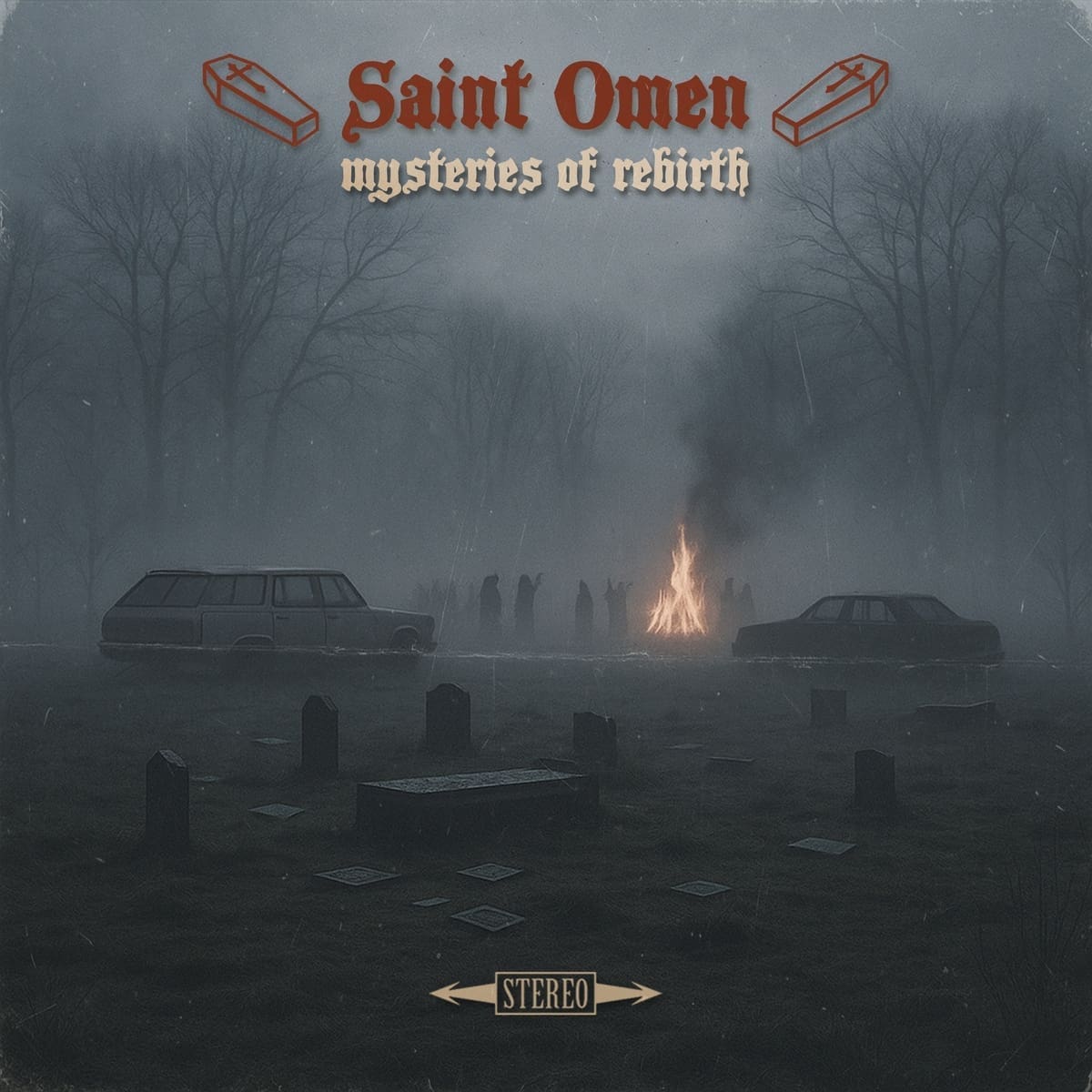
The Sixth Sin, The Artwork
The artwork stages the album as a grave-ritual drama, not just a doom release. Everything in the composition reinforces the themes of rebirth through fire, death, and initiation.
The Seventh Sin, Disrelish
There is no disrelish to be found within Mysteries of Rebirth. From the first invocation to the final fade of smoke, the ritual is absolute.
The Hymns
01. You Found It
02. Invocation Of Rebirth (Intro)
03. Hell Money
04. Devil Eyes
05. Bone Shakin’ Mama
06. Those Who Ham
07. Smokeless Fire
08. Satan Man
09. Mysteries of Rebirth
10. Undead
11. Levitation Communion
12. It Stays With You
Saint Omen
Geroni J. Saint-Hilaire – Everything